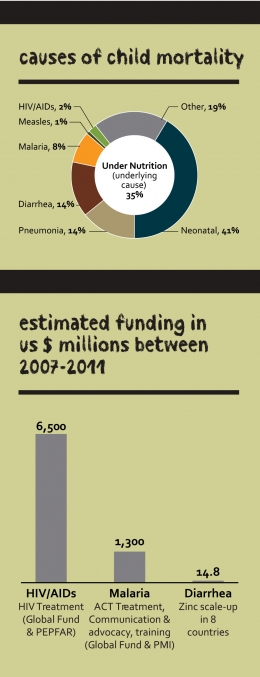
Causes of Child Mortality – Image courtesy of Population Services International
One of the purposes of the image, of course, is to show the stark contrast between directed funding for treatment and eradication of certain diseases and the number of children afflicted with these illnesses. How does this impact our understanding of global health and of the marketing around certain hot topic health issues and ways in which donors feel as though they are contributing to a decline in preventable deaths?
When I worked in development for HIV/AIDS organizations, it was fascinating to speak with donors about their reasons for giving and their understanding of the prevalence and incidence (and the general audience grasp of the word incidence, which is the measure of risk of contracting a certain illness or disease within a specified time frame) of HIV. Contrast this with the understanding of malaria, TB, diarrhea, deaths due to childbirth complications (for the mother and the infant), and the gap between perception and reality was startling. In no way do I want to deny the importance of consistent development support for all diseases on a global scale, but I do think there is something lacking in terms of the education around these issues for donors and even some advocates.
One of the most important things to remember about childhood and adolescence is that actions taken during that time are so often misunderstood in terms of their impact and their consequences, juveniles so often lack the ability to grasp the implications and depth of their choices, and they always lack real-world context. This is long overdue. It’s true that these sentences are often brought down upon juveniles who have committed atrocious acts, or were accessories in brutal crimes, but isolating the incident from the developmental stage is risky and unfair. Putting someone away without the affirmation that we also believe they can grow and develop and change is also a psychological judgment that would likely result in the juvenile’s agreeing self-assessment that they are unable to be rehabilitated.
Some of you public health and social marketing gurus have likely already come across the recent slew of ads in Georgia, published by an organization called Strong4Life, that are ostensibly part of an effort to curb childhood obesity. A lofty goal, indeed, but a misguided approach, the criticisms of which have already begun. The images are pictures of overweight and obese children with a variety of captions, including “It’s hard to be a little girl if you’re not,” and “Fat may be funny to you, but it’s killing me,” and “Fat prevention begins at home. And the buffet line.”
Shaming rarely works as a strategy for behavior change. It’s been shown in efforts ranging from drug use behavior to HIV-prevention goals and marketing campaigns. If you click on the images in the Strong4Life campaign you get taken to video spots of these children, who seem burdened by sadness and depression (which can be both causes of and side effects of being overweight – exacerbating these emotional states does not help in weight loss endeavors). Recognizing if one is at an unhealthy weight is an essential step towards healthy weight loss, but the children do not appear buoyed by information, support, and new ideas on ways to be healthy. They seem downtrodden and embarrassed, the very characteristics that a shaming and body-bullying culture easily pounce on and cultivate. The video of Bobby, which portrays a mother who appears shamed by her son’s question doesn’t make me want to hit the gym or eat a platter of vegetables. Instead, the voyeuristic quality of the mock confessions feels more than a bit exploitative and it triggers a gut reaction of sympathy and protectiveness, making me want to yank the camera from the hands of Strong4Life. It’s like they took a message from the Jillian Michaels’ school of adding insult to injury, splashing in an additional dose of fear and intimidation, and expecting that this will result in a lifelong substantial increase in meaningful self-esteem.
The well-developed criticisms of this campaign point out that not only does shaming and negative marketing not induce healthy behavior change, but that these ads do nothing educationally. One girl near-tearfully admits that she gets made fun of at school because she’s fat, and the video slams down a tag line of “being fat takes all the fun out of being a kid” before fading out. While the Strong4Life campaign has a “Get Started” tab offering facts about nutrition and screen time and physical activity, the impact of the original image has already been made. Advertising relies on quick one-liners, on stark imagery, and emotional reactions. In this case, what we see is a tag line reiterating that this girl is not a normal kid, a solitary image of an overweight girl connected to an emotional plea on her part of loneliness and victimization. It’s powerful all right, but not empowering. The ad emphasizes fat loss, heightening the importance placed on size, instead of cultivating an interest in healthy lifestyles and appreciation of the fact that people come in different sizes and can be equally healthy. Critics of the appreciation-of-all-sizes approach say it borders on supporting obesity, which I see as short-sighted. Very high weight status can certainly indicate other problems, like diabetes, early heart and respiratory problems, and difficulties engaging in physical activity. But it’s also essential to make sure that the message that larger sizes are universally unhealthy is quashed, and it’s vital to promote instead that appreciating people of all sizes is essential – and more importantly, that valuing people regardless of size is a priority. This is a topic that deserves that kind of nuance. I would welcome ads that excitedly show kids engaging in active lifestyles, enjoying sports and enjoying healthy, full diets – creating characters in ads that viewers want to emulate, as opposed to characters that viewers are meant to distance themselves from or who are meant to be repelling, is not only good business sense but inclusive and supportive. These ads further emphasize and underscore the cultural norm categories of “normal weight kids are normal” and “overweight kids are not normal and therefore not ok” – this certainly won’t help curb teasing or bullying in this arena. And since we do know that consistent, positive social support is one of the key factors in healthy behavior change, it’s obvious why public health experts met this series with skepticism. And here’s what else we know – healthy lifestyle changes significantly decrease mortality, regardless of baseline body mass index. Changes in fitness level are what alter all-cause mortality, not changes in BMI.
The response that these ads are cultivating “important conversation” is somewhat moot. It may get people talking, and it hopefully it will encourage media platforms with a larger audience than this blog to come out with constructive, evidence-based, supportive tips and strategies for a healthy lifestyle – but the fact remains that these ads are contributing to the negative, body-shaming noise that fuels so much of popular media and it remains that the effect can be really damaging and counter-productive at the outset. Individuals who ultimately are successful at losing large amounts of unhealthy weight (or who more consistently use condoms, for example) do so not merely because someone called them fat (or because they knew someone who became infected with HIV) – this has happened many times over to individuals seeking or needing to enact behavior change. The change happens because they not only begin to see themselves as deserving of these changes, but also because they become helpfully informed with concrete action steps that help move them through behavior change, are supported and consistently cheered on, and because they know what to do if they feel themselves slipping.
The bottom line is that discussions about healthy living need to happen to prevent long-term chronic health problems, and these conversations do need to happen early. But they shouldn’t start with shaming, embarrassment, or the putting on display of children who have weight problems and asking them to broadcast what’s so horrible about it while telling them that their love of the buffet is what got them to this point. We can do better.
…for making sure I didn’t actually take a few days off this holiday week!
What a charming little undergarment you were planning on selling to the masses this Black Friday:
Courtesy of the Sydney Morning Herald
Every 7 year-old girl needs a thong (like, I could end the sentence there!), an article of clothing designed for the sole purpose of sexually exciting others, that also broadcasts to the world that they’re diggin’ for gold before they’re even old enough to have a checking account of their own.
The perfect holiday gift for your first grader. The message that baring their buns will be rewarded with a wealthy partner. Cheers! And happy holidaze.
After watching the appalling, immature response to the rightful firing of Joe Paterno last night, I had difficulty sleeping. I could not reconcile in my mind how people were so willing to further discard these children who were victimized, further negate their trauma and reduce their suffering to something negligible and less important than the football trophies lining Penn State’s halls. I’m not introducing the main characters of this post, because by now I’m sure you all know them.
In situations like these, you don’t even have to say “I’m on Paterno’s side,” which is just what all the screaming rioters on Penn State’s campus and outside his home are doing. By bemoaning a lost season, a coach’s supposedly truncated career, a football team’s interrupted success, you are contributing your voice to the chorus of people who think this isn’t such a big deal. That the interruption of Penn State’s stellar season is actually what’s pretty sad! That a coach with such success deserves to be forgiven for some things! And they were awful things, but they happened years ago! And he reported it to the Athletic Director, so he did his job!
If you’re a rape or sexual assault victim, that chorus can sound mighty deafening. And ceaseless.
So, I’m here to tell you that this is a big deal. A really $&%/!*$ big deal. And I can’t help but cringe anytime I hear a comment on this issue that hints at anything otherwise. That Paterno didn’t have this in his control. That reporting a criminal act and the victimization of a child to an administrator with no follow-up was sufficient. That marching his ass down to the closest precinct wasn’t something he unquestionably should have done, and ensured that Sandusky didn’t get within a hundred yards of a kid ever again. We are told that we should do the best we can with what we know; Paterno and McQuery did nothing of any consequence with what they knew. They moved at a glacial pace and took actions that were of minimal requirement. They worked at a university and with students, whose well-being is ostensibly the greatest concern of any educational institution. In case anyone doubted that the cash cow athletics of some colleges is what is of greatest concern, I give you this sick and disturbing example. There is quite literally no excuse, no “explanation” of the multiple failures of multiple leaders, that doesn’t rest on the fact that compromising a winning and money-making football team was in no way an option, that this team would not be brought down by ANYthing, not even the physical, emotional, and mental sacrifice of children.
Do I sound pissed? You bet I am. You should be, too. Let’s try, for a daring second, to re-prioritize the issues of our country. Let’s move “college football” from its precious perch and consider the prevention of rape and sexual assault to be of greatest importance. The swift punishment of the criminals who perform these acts to be the first order of business, not falling behind the next desperate grasp for a game win, a series win, a university parade.
I don’t care much what happens to Paterno and the other members of a coaching or admin staff who have had blessed careers and public lives rife with success. What I care about is the little boys who suffered rapes, forced oral sex, molestation, tried to negotiate the fear, humiliation, anger, and physical ramifications of these. Who did not leave the locker rooms, living rooms, camping trips or tents with any swollen bank accounts, any buildings or stadiums named after them, any hordes of fans claiming that they supported them no matter what. Yep. I’m on their side.
And to those screaming Penn State students, knocking over news vans and co-opting an act (rioting) reserved for disenfranchised populations (of which you are not) to demonstrate their subjugation, I’m going to bring this down to as personal a level as I can. I ask of you this: You have a father. Or a brother. Or a son. Or a boyfriend. Or just a close friend. Someone you love and care deeply for. Imagine they had been anally raped in the Penn State locker room, and someone had walked in and seen it and done nothing. Walked right back out instead of saving him. And that the very man you are crowing about knew of it. And turned his head. And your father/brother/son/boyfriend/friend was ignored, his pain deemed not important or relevant, his subsequent suffering that you would have witnessed first hand dismissed and cast aside. Now picture him standing in front of this narcissistic crowd, and asking you to tell him to his face that his raping isn’t as important as your beloved football coach keeping his job. If you can easily do that, then we are in even more depraved trouble than I thought.
Respect the university! Nothing about those boys, still, who I knew were raped and assaulted, nothing about respecting them and their pain and ordeal. Respecting the university doesn’t appear to have been on Paterno or McQuery’s mind when they covered up rape, abuse and molestation cases that would ultimately be forever associated with the university and debase its reputation. They showed no respect for the little boys who lives were forever marked by the despicable actions of their buddy Sandusky. They created a chain of administrators and coaches who failed time after time to immediately stop and fix this. So, no, Paterno, despite that your plea was directed at your supporters, I’m pretty riled up and have lost respect for much of Penn State myself. Remain calm and respect the university? – that’s a mighty tall order. Don’t think I can fill it.
He followed his statements with this claim: “With the benefit of hindsight, I should have done more.”
A new study released by University of Buffalo sociologists discovered something truly ground-breaking: there has been an undeniable and increasing hyper-sexualiztion of images of women in popular media over the last several decades.
This is something that I would normally take notice of and file alongside the slew of reports that have similar conclusions and continue to confirm what I’ve always felt to be true about advertising and media presentations of women. Being a major theme of my blog, I occasionally worry that I’m Not Tired Yet will begin to sound like a broken record as I continue to write about how damaging media portrayals of women and girls truly are, and how it impacts human development, sense of self-worth, and definitions of beauty for both sexes.
That being said, as long as women and girls continue to be hyper-sexualized in images, videos, and advertisements, there have to be just as many consistent criticisms of them. Creating a chorus of opposition that shows growing girls this is not normal, not healthy, and that they have much, much more to offer than what our culture’s media is telling them they do through a ceaseless blasting bullhorn.
In this particular study, researchers’ conclusions did offer a concrete example of gender disparity in this realm. While representations of men and women have become increasingly sexualized, it was the intensity of the sexualization of women which was particularly shocking and far exceeded that of men. A scale was developed to rate the intensity of the level of sexualization of images, which showed evidence of women being far more likely to be in positions of submission or of offering pleasure as tools of hetero-male sexual desire. This sets a dangerous precedent – women are those who satisfy, men are those who are satisfied.
In the grand scheme of things, media not only influences our decisions and impacts our thinking, but is a reflection of these things as well – it’s a circuitous pattern of reinforcement and ever-heightening intensity. The more these images are sexualized, then the more it is socially expected for women to act as sexualized as they are portrayed, then the more sexualized the images become, building upon themselves as viewers need increasingly overt sexualization to feel excited or as though advertisements are pushing boundaries – which is what advertisements do to draw in a receptive audience. This causes two immediately obvious problems – first, that this pattern leads one down a path that ends in unquestioned and irrelevant nudity and commodification of the sexual identity of girls; secondly, we move farther and farther away from the objections that this kind of imagery is entirely inappropriate, sexist, pedophilic, and harmful.
A couple of weeks ago, I was invited to guest speak on a radio show about the effects of sexualization and violence in video games and media. One of the last questions the host asked me was, “So, what’s the solution? Should we censor these video games and movies?”
My response to this was no, of course I am against censorship. The free speech I advocate protects the video game developers (and advertisers, fashion labels, films, etc etc) as well as my criticism of them – which I will stop as soon as I see the egregious violence against women, forced sex acts and trivialization of women stop. That being said, there is an element of self-censorship — editing, if you will — that could certainly happen on the part of the creators. Until the developers want to change the games, they aren’t going to change – which is why I said that the ‘solution’ as it stands is keeping up the constant conversation, the constant writing, the constant research, that refutes the idea that these games (images, advertisements, movies, etc etc, that send the same messages) are just harmless entertainment. We know they aren’t. But the games (images, advertisements, movies, etc etc) keep selling and people keep buying because it’s seen as normal, and the media’s bottom line – $$ – is different than that of a parent, educator, coach, sibling, etc, who have concerns (hopefully) centered around the health of their children. So the ‘solution’ is to keep up the commentary, keep up the research, keep up the discussions about why these media messages are harmful, and ensure that parents, teachers, siblings, and, of course, anyone who are concerned about healthy children growing into healthy adults, are aware of why media matters and the kind of influence it is having.
Curbing the effects of non-stop media is difficult, but not impossible, and involves even more talking – this time directed at the kids. Getting media to change its tactics can feel damn near impossible, but keeping up a constant dialogue with children about the kind of messages they’re on the receiving end of can certainly help.
In the end, it comes down to what kind of society we want to cultivate – for us and our future generations. The kind of culture we want to look upon as having created – the definitions of gender, success, individual expression, and love – and having fostered. Is it one in which the bottom line is comprised strictly of financial and monetary goals, with little regard as to what happens to members of our communities and how our actions impact children and youth in pursuit of that goal? Or the opposite?
I got a lot of traffic and messages about a piece I wrote regarding Duke Nukem. People in the gaming community condemned it for its lack of originality, how it strayed from the original premise of apparently ostensibly mocking the ’80s action-hero genre, and how it overall disappointed those who are used to more complex and engaging videos. Some replies also included people needing to “get over it” when discussing images of coerced sexual activity or the game’s encouragement of merging violent and sexually explicit content together (I don’t post comments that are condescending or don’t encourage dialogue), something I found…disturbing. My initial argument, however, did not change – that is, that the imagery and the actions the gamer supposes in this video are tragically abusive and in fact detrimental to both men and women.
Many gamers also respond that they know when they are playing a game, and that their non-virtual socializing is not impacted by the game’s content. This, along with the recent news that the American Medical Association finally condemned the use of photoshopping in advertising campaigns and photo shoots, got me thinking about what repeated exposure to images and actions actually does to our brain and with who and what we identify.
A well-known study published in the Journal of Consumer Research found that repeated exposure to images and advertisements ultimately were processed in people the same way actual experiences were processed. That is, if you see or watch something enough times – in a video game, in a fashion magazine in which models are photoshopped to near obscurity, in a parent abusing your sibling – you begin to process it as though it was you yourself experiencing the act and identify with the “player” (model, game character) you are watching. You see enough pictures of a model like this:
Courtesy fashion-o-lic.com
And you begin to think you are supposed to align yourself with her, that this image is what is normal (the image on the right was criticized heavily in 2009 for being so drastically photoshopped). After so many exposures, you begin to mold yourself after her, to think that since this is how we project women for adoration in our culture, that you should begin appropriating yourself to match her image. Just like a gamer, after so many exposures, can begin to mold themselves after the image of the character they are impersonating in a game. And while they may not go out on a shooting spree, they are desensitized to the effects of that reality, just as they are desensitized to the effects of coerced sex in a game, which can lead to difficulty distinguishing that from a healthy sexual relationship.
We’re humans. We learn by watching, by then mimicking and imitating what we observe. It doesn’t happen all at once, which is why fashion moguls or game designers claim they have no real impact. Are girls entering periods of self-mandated starving as soon as they open this month’s Vogue? Are adolescent boys heading to the hills for a sawed off shotgun fight after the first round of Duke or stealing cars after playing the new Grand Theft Auto? No, of course not. But can it impact their sense of compassion, affect their interpersonal relationships? Can it make violence seem less threatening, less damaging, and less impacting than it is? Yes. Can that change the way people behave, from nuance to imitation? Sure. Even researchers who admit that it won’t necessarily turn children violent admit that’s likely true (and, interestingly, still disallow their children to play). Human development takes time – language acquisition, understanding of and the processing of visual messages, being able to comprehend meaning from a block of text – these are all cognitive functions that take years to develop and perfect, and their influence lies in the words and actions of children’s families, friends, teachers. Unfortunately, messages of gender have been largely commandeered by the media. And the repeated exposure, over years, to these specifics of models’ physical appearance has resulted in the erosion of self-confidence that many girls and women – and boys and men – experience as young children becoming adolescents. And the repeated exposure, over years, to the specifics of war, sexual violence, and the presentation of hyper-masculinity, can also result in the erosion of what kind of impact violence truly has, as they become desensitized, and what a healthy understanding of and relationship with the opposite sex is (as opposed to its portrayal in my Duke Nukem piece). As the study articulated, it’s about changing people over time, it’s about how perceptions and perspectives change when a new definition of the norm that is not contested or dissected – a Ralph Lauren model, a Duke Nukem – enters the picture. Women who suffer from eating disorders and body dysmorphia, while not blaming the fashion industry, have emphatically articulated that it certainly has had an impact as it normalized this destructive self-image and behavior.
I think it’s also relevant here to bring up the Supreme Court’s decision about a week ago to shoot down California’s attempt to ban the sale of violent video games to children. Timothy Egan, a Times columnist, had a great commentary on this, noting how ridiculous it seems for there to be a perpetual ban on nudity and sexually explicit images, but not on virtually dismembering a human or sexually assaulting a woman. It does seem…well, more than troubling, that a game in which a player can simulate murder and rape is protected by free speech but a bare breast is the height of vulgarity. (I found a great post from a female gamer about this kind of sexual violence in video games, and I agree with her assertion that sexual expression can in fact exist without it also involving violence and degradation.) I don’t think any of the representations of sexuality that I have seen in video games are appropriate for children because they overwhelmingly associate it with abuse and/or coercion (I’ve done a lot of viewing in the past couple days after my Duke Nukem post). To say that sexuality would have a more harmful impact than violence seems questionable, when representations of both are equally unhealthy.
It should also be said that I am far from someone who believes nudity and sexuality itself is vulgar. I celebrate and support healthy (and protected!) sexual expression in any way the individual consents and desires. I firmly believe that discussions of sex and sexuality should be brought up early on, so children can ask questions, be informed, protect themselves when they do engage in sex, and have an understanding of what a respectful, consensual sexual relationship is. I also believe that when these discussions in families don’t take place, and when sex is a taboo topic, that it is a disservice to these children, and that any confusion they have about sex or uncertainty about what a healthy sex life actually is will be magnified by the messages the media sends them. I’m an advocate of early onset, comprehensive sexual health and reproductive health education. Sex shouldn’t be confusing, and it shouldn’t be stigmatized. Sexual violence, however, and a misappropriation of the presentation of sexual relationships that are abusive, coercive, and violent, should be condemned.
This is also why a diversity of exposures is important. It’s important to not be inundated with the same message over and over again. Advertisers know that repeated exposure is key to getting people to buy what they want to sell. If you see an image of a Coke bottle once, it won’t register with much impact. If you see it every time your favorite TV show breaks for commercial, when you’re leafing through the pages of a magazine, when you’re driving down a freeway and it’s up on a billboard, when you’re listening to the radio and it breaks for the Coke jingle – it adds up, as do afternoons in front of a game console, as do hours reading “women’s” magazines and fashion spreads, as do episodes of spousal or child abuse, (which we know increases the likelihood of the child being in an abusive relationship him/herself and hampers healthy development – the others are logical extensions, to a lesser degree). We have to have enough positive images, positive games, positive and healthy discourse about relationships to not just equal the stream of negative imagery and messaging, but to overtake it. Positive, healthy messages, not abusive, harmful, violent messages, have to be in the majority. The norm. It’s nice that the docs finally said so.
Ross Douthat, one of the NY Times conservative columnists whose pieces I occasionally force myself to read, wrote an article yesterday about sex-selective abortion. In short, he claimed that the reason 160 million women were “missing” (that is, the reason they were so outnumbered in many countries like India and China, as well as other nations in the Balkans and Central Asia) was because they were “killed” via sex-selective abortion. In his words, the women weren’t “missing,” they were “dead.” (He also claims that the author of the book he cites, Mara Hvistendahl of the book “Unnatural Selection: Choosing Boys Over Girls, and the Consequences of a World Full of Men,” appropriates the issue to one of patriarchy, of greater social issues and inequities – which I agree with. He then says that “the sense of outrage that pervades her story seems to have been inspired by the missing girls themselves, not the consequences of their absence,” saying that she is more upset by the idea of abortion itself than she is about the issues surrounding abortion. Don’t you think that’s for her to decide? And doesn’t it seem she’s already decided what she thinks based on her book?)
Douthat, however, manages to contradict the crux of his argument near the start of his column.
He begins by saying “female empowerment often seems to have led to more sex selection, not less.” He then quotes Hvistendahl as saying “women use their increased autonomy to select for sons,” because male offspring bring higher social status. In countries like India, sex selection began in “the urban, well-educated stratum of society,” before spreading down the income ladder.
If this were the case – if in fact women had become truly empowered in their respective lands – culturally, politically, economically – then why would they be aborting based on the opposite – that men in their communities are still holding the cards? Are they imagining that men still hold positions of power and wealth in their countries, or are they living the ramifications of that painful reality everyday? Women do have some increased autonomy in many of these regions. But guess what? This autonomy has likely served to highlight the still very real inequities and disparities that exist in their communities, which contributes to the rates of sex-selective abortion. If women see which sex has the higher status, and one of the few autonomous decisions they can make is to choose the sex of their baby – they are likely going to choose the one with more status. This upsetting power dynamic shows just how far away true empowerment is for many of these women and their communities. If they felt their children would have the same opportunities if they were female than if they were male, the sex selection abortion Douthat decries would actually decrease. It is not the responsibility of the female fetus to ensure she is treated with the same respect and equality as the male fetus. Douthat seems to really care about female fetuses – but seems less interested in addressing the massive social, political, and economic issues that create so many difficulties for them once born. (His colleagues Paul Krugman and Nick Kristof seem to have handles on that. Too bad they were off yesterday.)
It seems that Douthat wants to push for the feelings of regret and remorse about abortion itself, separate from the issues surrounding it. Does sex-selection abortion sadden me? Yes. Does aborting a fetus that indicates it will have Down Syndrome sadden me? Yes. You know what else makes me sad? That a woman cannot afford a baby because she is single and has no familial or community support; because she has an abusive partner (homicide is the number one cause of death for pregnant women); because she has a low-wage hourly job that offers no maternity leave which could help her stay well while carrying the baby if needed; because she has no health insurance meaning she can’t access quality pre-natal care to make sure her baby would be healthy since we are systematically closing down those facilities that offer services for women who are uninsured (and also help provide birth control to prevent pregnancy!); because she has no way to pay for day care and she may have to quit her low-wage job to care for her baby; because she would then have no money for all the supplies, food, and developmental tools her baby would need to thrive which can lead to malnutrition, behavioral problems, child depression; because she could then become part of the 29.9% of families in poverty that are headed by single women, and her child could become part of the 35% of those in poverty who are under 18 years of age – the poverty rate for households headed by single women is significantly higher than the overall poverty rate.
We’ve cut child welfare services that aid women by the tens of millions in the past few years. Georgia alone cut over $10 million in Child Welfare Services. We’ve also cut subsidies that support adoption agencies – the organizations that help women find families that may be able to care for her baby were she to carry it to term – and who make sure these families are actually fit to do so! TANF (Temporary Assistance for Needy Families) provides women and families with aid so that children can be raised in their own homes or with relatives, instead of being placed in foster care and becoming wards of the state. How much have we cut from TANF? 17 of the poorest states, with some of the highest poverty rates in the nation, have already stopped receiving funds.
Birth control, one might say? Sure – birth control is expensive, so if she doesn’t have health insurance, she isn’t likely to be able to afford birth control (hey, Planned Parenthood can help with that, too! Seeing a pattern?) And if her partner refuses to wear a condom? If she is in an abusive relationship, if she fears leaving her partner, if she relies on her partner for added economic security – she’s much less likely to argue with him about the condom use. Or even feel that she has the agency to begin a negotiation discussion at all.
These facts make me sad. And all of these facts might lead a woman to decide she can’t have a baby. And many things not listed here may lead a woman to decide that she will not have a baby. And that she will have an abortion. Is it my decision? No. It’s not. It’s not yours or Ross Douthat’s, either. Again, Douthat represents the contingent of pro-lifers who want to make it seem like pro-choicers are cheering the performing of abortions right and left. What we are cheering is the right for women and respect of women to make their own decision based on their very specific personal circumstances. And given the fact that the medical establishment has not agreed with the pro-life camp in claiming that fetuses before a month into the third trimester can feel pain (reacting to stimuli does not equal pain, to reiterate, and pain without a cerebral cortex is seen by physicians as not possible), which has most recently become the pro-life camp’s wildly off-base rationale for preventing a woman’s right to choose, and given the fetus’ place of residence in the woman’s uterus as a part of her body, not as a human, these issues that Douthat sees as “sideline” are actually very much at the center of the argument. Bottom line – it’s the woman’s body. It’s the woman’s choice. She will be the one carrying it, she will be the one birthing it. No one else. So why should anyone else decide?
Additionally, it is not a crime for a woman to not want children. Since she is able to give birth, it is her decision as to when and how that will happen. Everything about her life and future will change once she has a baby. So she needs to be sure she is ready for that. How can one disagree with that? Douthat may not like it, but “the sense of outrage that pervades his story” (see what I did there? 😉 ) seems to me more rooted in his anger and frustration with his opinion not being considered by women in these decisions and not being able to control what a woman decides to do about what is going on in her body.
All of the things I listed – the job issues, the healthcare issues, the family and community issues, the issues that arise when a child doesn’t have access to food, clothing, and developmentally appropriate stimulation – are the causes. So why don’t we start figuring out how we can mitigate those facts and issues instead of attacking the effect – the abortion – which is a decision women come to after weighing all of those facts and issues just discussed. Douthat’s fear tactics of talking about female fetuses strewn across Indian hospitals is scary imagery. So is this:
Photo thanks to ehow.com
And this:
Photo via Captain Hope's Kids Blog
And this:
Photo property of streetkidnews.blogsome.com
Want less abortions? How about providing health insurance, that covers both birth control and pre-post natal care? How about equal pay for equal work, so women are more financially and economically secure, providing them with the resources to stay out of poverty and keep their children out of it, too? How about child care in work environments, helping women who cannot afford day care can stay in their jobs and remain a part of the economy? While we’re at it, how about great public schools and clean community centers, so women know their children are being intellectually fed and socially stimulated in safe environments that help keep them out of more dangerous and potentially life-threatening social circles? How about comprehensive sex education so men and women know how to protect themselves not only from pregnancies but from diseases that can endanger a fetus and create complications during birth and cause health issues for them and their children – creating more expense, particularly if one has no health insurance.





 Larkin Callaghan