How Are Gen Y Women Faring in the Workplace? (A Mini-Exploration)

I came across this intereting post via Mashable courtesy of Accenture, detailing how Gen Y women are faring in the workforce. Some interesting points:

I thought the statistic that 30% of women said work-life balance is the most important career factor was interesting. Regardless of whether or not children are desired by a woman, I would think that work-life balance remains a pressing concern – particularly given what we know about work-related stress and its impact on our health.

What I found most fascinating, however, was that nearly half of women surveyed said that they felt their career was being held back because of lack of a defined path or lack of opportunities, and a third of them felt that their career path was stagnant. I’d love to delve deeper into that, given how many factors are likely at play – fewer people retiring at age 65 means less opportunity to rise within organizations, job uncertainty makes even attempts at lateral moves to different companies or organizations a risk, lack of mentorship and weak relationships with supervisors are often also culprits. It makes me wonder how this may make women ambivalent about leaving their jobs when they do have families – if they feel no connection or support within the work system, the impetus to return may be low.

Statistics about advocating for themselves in regards to pay raises and clear conversations about career growth are nothing new – studies for many years now have shown that women are less likely to do these things as well as less likely to negotiate salaries during hiring processes as well. But when women are given tips for broaching this subject and outlines for structuring conversations about career growth, they take them – and they are often successful. So how do we make these conversations more natural for everyone to have? How can we incorporate the development of these skills into education for women as well?

Thoughts? Comments? Let me know on Twitter.

Social Media and Higher Education

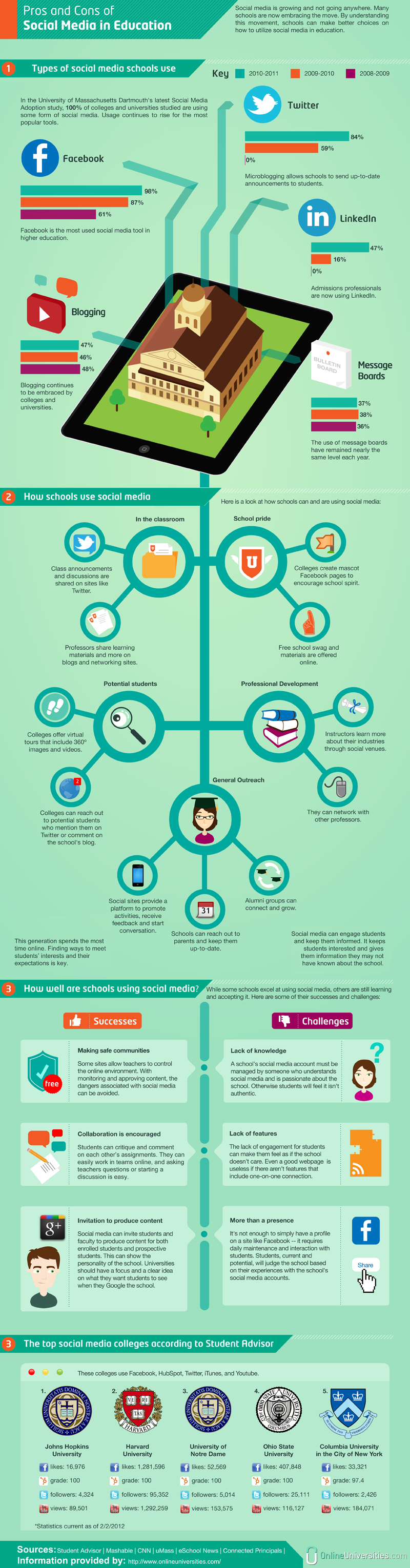
Interesting infographic of the use of social media in higher education. Courtesy of the Online Universities and Columbia Teachers College EdLab:

I think this is interesting for a few reasons. What role does social media have in the administration of universities? How can they utilize social media to promote their in-house programs for students? What actually prompts students to follow higher education institutions on social media sites (aside from loyalty to their alma mater)?

Shame Won’t Make You Healthy. Really.

Some of you public health and social marketing gurus have likely already come across the recent slew of ads in Georgia, published by an organization called Strong4Life, that are ostensibly part of an effort to curb childhood obesity. A lofty goal, indeed, but a misguided approach, the criticisms of which have already begun. The images are pictures of overweight and obese children with a variety of captions, including “It’s hard to be a little girl if you’re not,” and “Fat may be funny to you, but it’s killing me,” and “Fat prevention begins at home. And the buffet line.”

Shaming rarely works as a strategy for behavior change. It’s been shown in efforts ranging from drug use behavior to HIV-prevention goals and marketing campaigns. If you click on the images in the Strong4Life campaign you get taken to video spots of these children, who seem burdened by sadness and depression (which can be both causes of and side effects of being overweight – exacerbating these emotional states does not help in weight loss endeavors). Recognizing if one is at an unhealthy weight is an essential step towards healthy weight loss, but the children do not appear buoyed by information, support, and new ideas on ways to be healthy. They seem downtrodden and embarrassed, the very characteristics that a shaming and body-bullying culture easily pounce on and cultivate. The video of Bobby, which portrays a mother who appears shamed by her son’s question doesn’t make me want to hit the gym or eat a platter of vegetables. Instead, the voyeuristic quality of the mock confessions feels more than a bit exploitative and it triggers a gut reaction of sympathy and protectiveness, making me want to yank the camera from the hands of Strong4Life. It’s like they took a message from the Jillian Michaels’ school of adding insult to injury, splashing in an additional dose of fear and intimidation, and expecting that this will result in a lifelong substantial increase in meaningful self-esteem.

The well-developed criticisms of this campaign point out that not only does shaming and negative marketing not induce healthy behavior change, but that these ads do nothing educationally. One girl near-tearfully admits that she gets made fun of at school because she’s fat, and the video slams down a tag line of “being fat takes all the fun out of being a kid” before fading out. While the Strong4Life campaign has a “Get Started” tab offering facts about nutrition and screen time and physical activity, the impact of the original image has already been made. Advertising relies on quick one-liners, on stark imagery, and emotional reactions. In this case, what we see is a tag line reiterating that this girl is not a normal kid, a solitary image of an overweight girl connected to an emotional plea on her part of loneliness and victimization. It’s powerful all right, but not empowering. The ad emphasizes fat loss, heightening the importance placed on size, instead of cultivating an interest in healthy lifestyles and appreciation of the fact that people come in different sizes and can be equally healthy. Critics of the appreciation-of-all-sizes approach say it borders on supporting obesity, which I see as short-sighted. Very high weight status can certainly indicate other problems, like diabetes, early heart and respiratory problems, and difficulties engaging in physical activity. But it’s also essential to make sure that the message that larger sizes are universally unhealthy is quashed, and it’s vital to promote instead that appreciating people of all sizes is essential – and more importantly, that valuing people regardless of size is a priority. This is a topic that deserves that kind of nuance.  I would welcome ads that excitedly show kids engaging in active lifestyles, enjoying sports and enjoying healthy, full diets – creating characters in ads that viewers want to emulate, as opposed to characters that viewers are meant to distance themselves from or who are meant to be repelling, is not only good business sense but inclusive and supportive. These ads further emphasize and underscore the cultural norm categories of “normal weight kids are normal” and “overweight kids are not normal and therefore not ok” – this certainly won’t help curb teasing or bullying in this arena. And since we do know that consistent, positive social support is one of the key factors in healthy behavior change, it’s obvious why public health experts met this series with skepticism. And here’s what else we know – healthy lifestyle changes significantly decrease mortality, regardless of baseline body mass index. Changes in fitness level are what alter all-cause mortality, not changes in BMI.

The response that these ads are cultivating “important conversation” is somewhat moot. It may get people talking, and it hopefully it will encourage media platforms with a larger audience than this blog to come out with constructive, evidence-based, supportive tips and strategies for a healthy lifestyle – but the fact remains that these ads are contributing to the negative, body-shaming noise that fuels so much of popular media and it remains that the effect can be really damaging and counter-productive at the outset. Individuals who ultimately are successful at losing large amounts of unhealthy weight (or who more consistently use condoms, for example) do so not merely because someone called them fat (or because they knew someone who became infected with HIV) – this has happened many times over to individuals seeking or needing to enact behavior change. The change happens because they not only begin to see themselves as deserving of these changes, but also because they become helpfully informed with concrete action steps that help move them through behavior change, are supported and consistently cheered on, and because they know what to do if they feel themselves slipping.

The bottom line is that discussions about healthy living need to happen to prevent long-term chronic health problems, and these conversations do need to happen early. But they shouldn’t start with shaming, embarrassment, or the putting on display of children who have weight problems and asking them to broadcast what’s so horrible about it while telling them that their love of the buffet is what got them to this point. We can do better.

Sebelius Caves, Girls Pay the Price

By now, I’m sure you’ve all heard that Kathleen Sebelius, the Secretary of Health and Human Services, has blocked the recommendation of the Food and Drug Administration that the over the counter (OTC) drug Plan B, commonly known as the ‘morning after pill,’ be made available without a prescription for girls of all ages. It is currently available without a prescription to girls ages 17 and up, and requires a prescription for girls ages 16 and below.

It is worth noting that this is the first time a Secretary of HHS has overruled the FDA. This is not insignificant. The purpose of HHS is to promote the health, safety, and well-being of Americans. The FDA is an obvious component of this. While the FDA is an agency of HHS, the purpose of the FDA is to promote and protect public health, through the regulation of OTC and prescription medications, vaccines, food safety, medical devices, and more. They do this through clinical trials and testing, which is how we come to know of drugs’ side effects as well as how significantly they aid in the relief of what they purport to treat. The FDA recruits researchers who understand both the purpose of and execution of this research. Attempts have been made to loosen the regulations of the FDA; for example, some terminally ill patients have petitioned the FDA to allow them to access experimental drugs after Phase I of a trial – the FDA has denied these requests due to the lack of research regarding a drug’s long-term effects post- Phase I. The FDA is not without criticisms; they have been accused of being both too hard and too lax on the pharmaceutical industry. Members of the FDA have also expressed feeling pushed to present certain results. Scientists at the FDA complained to Obama in 2009 that they felt pressured under the Bush administration to manipulate data for certain devices, and the Institute of Medicine also appealed for greater independence of the FDA from the powers of political management.

The commissioner of the FDA, who is a physician, reports to the Secretary of HHS. Sebelius’ job is not one of medicine or research, and requires a background in neither. It does require a background in politicking, which is exactly what we’re seeing here. The purpose of pointing that out, and of articulating that this is the first time a Secretary of HHS has overruled an FDA recommendation, is that Sebelius’ refute would not be based on differing scientific results, or research that opposes the FDA’s recommendations – because there is none. The override has different drivers, and the assumption floating out there – for good reason, since there is little alternate explanation – is to appease social conservatives and the anti-abortion contingents.

Plan B is not the abortion pill. It is the equivalent of an increased dose of a daily birth-control pill, and has no effect on already established pregnancies – it prevents pregnancy from occurring. Scientists within the FDA unanimously approved the access of the drug without a prescription for girls of all ages, after an expert panel put the recommendation forward. It is, to quote a USC pharmacist, one of few drugs that is so “simple, convenient, and safe.”

The conservative Family Research Council claims that requiring a prescription will protect girls from sexual exploitation and abuse – I fail to see how requiring a girl to get a prescription will protect against sexual violence, especially since girls may be attempting to get Plan B because sexual violence has already occurred. This comment is also a flagrant indication of misunderstanding of sexual violence and abuse – a young girl is not likely to disclose to an unknown physician that she is being sexually abused or assaulted and that’s why she needs a prescription for Plan B. Make no mistake, this ban is a victory for anti-abortion rights activists. If a girl cannot prevent a pregnancy from occurring, she is subsequently faced with trying to terminate an existing pregnancy (again – that could have been prevented!). Given how reproductive and abortion rights have been systematically chipped away at for the past few years, this girl who did not want the pregnancy and tried to prevent it from happening but was denied because she is shy of 17 years, will be in an even worse position. This is what anti-abortion activists are counting on – that once she is pregnant she will have to carry to term.

Plan B can prevent abortions from happening. HHS, with its mission of protecting the health and welfare of all citizens, should do everything they can to protect the health of girls’ reproductive development, which includes the prevention of unwanted pregnancy at its earliest stage. The girls under the age of 17 who need Plan B the most are the ones who also need it to be as easily accessible as possible. Much like requiring parental permission for abortions for girls under the age of 18, this ban actually can put girls at risk. Many girls will not have the family support, financial means, or healthcare to manage a pregnancy; some girls may face parental and familial abuse if they have to admit to needing to prevent a pregnancy with Plan B. What if a girl is a victim of sexual assault within her family? Should she be forced to deal not only with this trauma, but also have to determine how to prevent herself from being forced to carry a fetus to term as a result of this tragedy? Most girls under the age of 17 do not have easy access to clinicians and hospitals on their own, nor are they able to navigate our increasingly complex healthcare system on their own, which they would not only need to do to access Plan B, but would need to do within 72 hours for the pill to be effective. Girls whose bodies are not ready for pregnancy, girls who were victims of assault and rape and incest, girls whose futures will be dramatically changed and opportunities truncated – they all become casualties of this ban. Before we start sex-shaming and proclaiming that they shouldn’t have had sex if they didn’t want to deal with the consequences, let’s remember that these girls were not miraculously impregnated. Whether consensual or not, a boy was involved. This is a gendered issue – the girls are the ones who will have to deal with the lack of access to Plan B, physically, mentally, and emotionally.

Originally, advocates in 2003 successfully petitioned Plan B to be available OTC for girls 18 and up (after having been available with a prescription since 1999), but a judge overruled that decision and lowered the age to 17 after he deemed the decision had been made politically, not for scientific reasons. It appears that history is repeating itself.

Thanks, KMart

…for making sure I didn’t actually take a few days off this holiday week!

What a charming little undergarment you were planning on selling to the masses this Black Friday:

Courtesy of the Sydney Morning Herald

Every 7 year-old girl needs a thong (like, I could end the sentence there!), an article of clothing designed for the sole purpose of sexually exciting others, that also broadcasts to the world that they’re diggin’ for gold before they’re even old enough to have a checking account of their own.

The perfect holiday gift for your first grader. The message that baring their buns will be rewarded with a wealthy partner. Cheers! And happy holidaze.

Good Riddance, Paterno.

After watching the appalling, immature response to the rightful firing of Joe Paterno last night, I had difficulty sleeping. I could not reconcile in my mind how people were so willing to further discard these children who were victimized, further negate their trauma and reduce their suffering to something negligible and less important than the football trophies lining Penn State’s halls. I’m not introducing the main characters of this post, because by now I’m sure you all know them.

In situations like these, you don’t even have to say “I’m on Paterno’s side,” which is just what all the screaming rioters on Penn State’s campus and outside his home are doing. By bemoaning a lost season, a coach’s supposedly truncated career, a football team’s interrupted success, you are contributing your voice to the chorus of people who think this isn’t such a big deal. That the interruption of Penn State’s stellar season is actually what’s pretty sad! That a coach with such success deserves to be forgiven for some things! And they were awful things, but they happened years ago! And he reported it to the Athletic Director, so he did his job!

If you’re a rape or sexual assault victim, that chorus can sound mighty deafening. And ceaseless.

So, I’m here to tell you that this is a big deal. A really $&%/!*$ big deal. And I can’t help but cringe anytime I hear a comment on this issue that hints at anything otherwise. That Paterno didn’t have this in his control. That reporting a criminal act and the victimization of a child to an administrator with no follow-up was sufficient. That marching his ass down to the closest precinct wasn’t something he unquestionably should have done, and ensured that Sandusky didn’t get within a hundred yards of a kid ever again. We are told that we should do the best we can with what we know; Paterno and McQuery did nothing of any consequence with what they knew. They moved at a glacial pace and took actions that were of minimal requirement. They worked at a university and with students, whose well-being is ostensibly the greatest concern of any educational institution. In case anyone doubted that the cash cow athletics of some colleges is what is of greatest concern, I give you this sick and disturbing example. There is quite literally no excuse, no “explanation” of the multiple failures of multiple leaders, that doesn’t rest on the fact that compromising a winning and money-making football team was in no way an option, that this team would not be brought down by ANYthing, not even the physical, emotional, and mental sacrifice of children.

Do I sound pissed? You bet I am. You should be, too. Let’s try, for a daring second, to re-prioritize the issues of our country. Let’s move “college football” from its precious perch and consider the prevention of rape and sexual assault to be of greatest importance. The swift punishment of the criminals who perform these acts to be the first order of business, not falling behind the next desperate grasp for a game win, a series win, a university parade.

I don’t care much what happens to Paterno and the other members of a coaching or admin staff who have had blessed careers and public lives rife with success. What I care about is the little boys who suffered rapes, forced oral sex, molestation, tried to negotiate the fear, humiliation, anger, and physical ramifications of these. Who did not leave the locker rooms, living rooms, camping trips or tents with any swollen bank accounts, any buildings or stadiums named after them, any hordes of fans claiming that they supported them no matter what. Yep. I’m on their side.

And to those screaming Penn State students, knocking over news vans and co-opting an act (rioting) reserved for disenfranchised populations (of which you are not) to demonstrate their subjugation, I’m going to bring this down to as personal a level as I can. I ask of you this: You have a father. Or a brother. Or a son. Or a boyfriend. Or just a close friend. Someone you love and care deeply for. Imagine they had been anally raped in the Penn State locker room, and someone had walked in and seen it and done nothing. Walked right back out instead of saving him. And that the very man you are crowing about knew of it. And turned his head. And your father/brother/son/boyfriend/friend was ignored, his pain deemed not important or relevant, his subsequent suffering that you would have witnessed first hand dismissed and cast aside. Now picture him standing in front of this narcissistic crowd, and asking you to tell him to his face that his raping isn’t as important as your beloved football coach keeping his job. If you can easily do that, then we are in even more depraved trouble than I thought.

After the absurd riots started following his firing, Paterno said that he appreciated the outpouring of support but to please “remain calm and respect the university, its property, and all that we value.”

Respect the university! Nothing about those boys, still, who I knew were raped and assaulted, nothing about respecting them and their pain and ordeal. Respecting the university doesn’t appear to have been on Paterno or McQuery’s mind when they covered up rape, abuse and molestation cases that would ultimately be forever associated with the university and debase its reputation. They showed no respect for the little boys who lives were forever marked by the despicable actions of their buddy Sandusky. They created a chain of administrators and coaches who failed time after time to immediately stop and fix this. So, no, Paterno, despite that your plea was directed at your supporters, I’m pretty riled up and have lost respect for much of Penn State myself. Remain calm and respect the university? – that’s a mighty tall order. Don’t think I can fill it.

He followed his statements with this claim: “With the benefit of hindsight, I should have done more.”

How hollow that rings.

Feminism in Zambia: Finding an Unexpected Champion

Our last guest post this month is by Stephanie Reinhardt. Stephanie is a Program Officer with Jhpiego and is currently working to support HIV/AIDS and maternal health programs in east and southern Africa. Growing up in San Francisco and joining forces with Larkin Callaghan at the age of 4 has left her overly opinionated and easily distracted by all the exciting things around her. Hey look – a baboon just walked by my office window! When she’s not bouncing around the globe, she’s very busy procrastinating.

Gabriel, a Zambian taxi driver who works outside an overpriced hotel in the capital Lusaka, drove me to a township on the outside of town last week. We started with the usual conversation.

“Where are you from?” he asked.

“California,” I responded, “though I’m starting to feel like Zambia is my second home”.

I’ve been to Zambia six times in the past four years supporting public health programs run through Jhpiego, an affiliate of Johns Hopkins. After some discussion about various locations in the US he had learned about from other passengers, he jumped into his favorite story about American history to see if I knew it as well.

After slowing his taxi to traverse a particularly rough patch of potholes, Gabriel looks at me and said, “Well, you know about the Gremich sisters?” (Upon further research, I learned the correct spelling of Grimké sisters). I shook my head no, which gave Gabriel the green light to dive into his story:

“During the time of slavery in America (perhaps in California, or Texas or wherever), there were two sisters who wanted to put an end to slavery.”

I jumped in to briefly describe (with my best recollections from high school) the divisions between the north and the south that eventually led to the civil war, which I explained, for future reference was on the east coast of America, so I would guess that the Grimké sisters were probably from a state like New York. (Turns out they were from South Carolina, but later joined abolitionist circles in Philadelphia, New York and New Jersey.)

Gabriel gave me a polite nod, but the civil war was clearly not his target conversation. With the eagerness of a school kid sitting in the front row, he continued his story, which he credited to a book he had read called, No Fear of Trying. Gabriel’s eyes grew large as he told the story of these sisters’ amazing bravery to publicly speak out against slavery. He looked at me and repeatedly tapped the top of the steering wheel with his palm to emphasize the profundity of this story. “These were the first women to speak at a podium…to men. Women did not do that at that time.” He described the message of equality and freedom that they took all the way to the US government. “People thought that women should not give public speeches to men. Lots of people threatened them and told them to stop, but these women were so brave, ” he continued. I was nodding in agreement, but apparently not giving the reaction he wanted.  “Isn’t that amazing?” he exclaimed. “It’s great!” I responded.

Despite a few factual inaccuracies (that the Gimké sisters final speech ended slavey, and this all took place in the 1950s), Gabriel’s story is pretty spot on. The Grimké sisters grew up in South Carolina with all the advantages of a privileged class awaiting them.  Unlike many other northern born abolitionists, the Grimké sisters had seen slavery first hand and felt compelled to not only put an end to the practice, but to put an end to racial and gender discrimination – an idea radically progressive for their time. They promoted extremely advanced messages for both racial and gender equality. Angelina Grimké letters demanded “educational reform, equal wages and an end to other forms of discrimination against women.”

What fascinated me most about Gabriel’s story was not that I was previously unaware of this significant historical biography (I am never shocked by the amount of information I don’t know or frankly, don’t remember). Rather, I was completely taken aback by his emotional response to this story. He loved these women for their bravery to stand up to men and wanted to share it with anyone who got in his cab.

Zambia is not a country known for its progressive gender relations. Women unfortunately still live very much as the mercy of their husbands, cultural laws and the State. As explained in a 2002 OMCT report on violence against women in Zambia:

Women in Zambia currently face many obstacles to the realisation of their human rights including high rates of violence against women in the family, in the community and by the State, discrimination in the application of customary laws relating to family and inheritance rights, low levels of representation in political and other decision-making structures, a lack of access to education and employment opportunities, poor health care services and the limited availability of affordable contraception.

The 2007 Zambian Demographic Health Survey (DHS) included an assessment of women’s empowerment by asking questions on employment and decision-making.  While great variations exist with regard to education level and location, overall 37 percent of men think that decisions about how to spend the wife’s cash earnings (if she has employment outside of the home) should be made mainly by the husband.  These views extend to a woman’s body as well – 46 percent of men think that the husband alone should make the decision on the number of children to have.  Only 64.8 percent of currently married women responded that they are the primary decision makers or make joint decisions with their husbands regarding their own health care.

So, given this context, I was baffled. I wondered if I had stumbled into the cab of an outspoken Zambian male feminist. As Gabriel’s taxi approached our destination, I probed him on his thoughts on women’s rights in Zambia. “Oh,” he responded, “we have learned a lot from Americans. Everyone is equal here.” Then he dropped the famous development buzz word “gender” and it was all over. “Yes, we have learned gender is important, so now we are all equal.” Ack.

I was hugely disappointed. My image of this Zambian male taxi driver in a superhero outfit championing women’s rights quickly vanished. I thanked him for the ride and started to get out of the car. As I was about to depart, he pulled out a small piece of paper and said, “You work in health? Can I ask you a question?” I nodded, and he continued: “My wife has decided that we should only have three kids, and so we want to stop now that we have three. Can you look at this list and tell me what you would recommend?” On the piece of paper was a list of family planning methods that they had received from their local clinic. I sat with him and explained the differences between some of the short term methods and the long term methods. I also described the vasectomy process should he be interested in the procedure. I explained that if his wife wants no more kids, a long term method, such as an IUD might be best, as it offers protection for 5-7 years. He smiled and responded, “Great, thank you. I will tell my wife this information and see what she wants to do.”

Maybe we have our champion after all.
99 Problems But A Gay Ain’t One: A Look at Gay Men and Reality Television

Our next guest post is by Zel McCarthy. Zel is a media professional and blogger based in Los Angeles. He tweets about music, politics, and nail polish at @ZelMcCarthy.

On a recent episode of Bravo’s show Most Eligible Dallas, likable girl-next-door Courtney told the camera about how much she enjoys her friendships with gay men. As she put it, paraphrasing Jay-Z, “I’ve got 99 problems but a gay ain’t one.”

In the following episodes that would prove to be true, even as one of her gay friends, Drew, picked a public fight with her over some mysterious and vague issue loosely regarding a lack of attention. That’s how friendships work on reality television: paradise to category 5 in a single episode. Truly, Drew is never a major problem for Courtney. While she hates when anyone dislikes her, Courtney’s biggest issue is (of course) finding a husband, who may or not be her best friend Matt.

It’s always bothered me when someone converts the word “gay” from adjective to noun. Comedian and Bravo star Kathy Griffin practically pioneered the noun-ing of “gay” by frequently referring to her homosexual friends, fans, and followers as “my gays.” Even if it’s not being used pejoratively, it’s always reductive. Instead of a person or man or even a self-obsessed reality TV personality, he is merely a sexual orientation. (Mind you, the phrase is never used to refer to gay women. They are excluded almost completely from Bravo’s narrative of gender and sexuality in society.)

Even more bothersome, however, is that gay characters on reality TV are so marginalized and stereotypical that they never get to be someone’s problem, much less have problems of their own. In fact, aside from fueling the on-screen drama necessary for its programming to function, gay men on Bravo’s slate of shows, like Drew from Dallas, are ubiquitous but never problematic because they are never the central figure of a story.

Whether watching the Real Housewives franchise, The Rachel Zoe ProjectPregnant In HeelsMiami Social, or Bethenny, the message is clear: if you are a gay man, you can be a human accessory in a rich woman’s life. From Jill Zarin’s “gay husband” to Kyle Richards’ “ladysitter” to the coterie of hairstylists, decorators, and event planners orbiting around an endless supply of narcissistic women, gay men are written to serve two functions: enhance the aesthetics of their mistresses, and act as a stand-in for the straight men in their life.

Even gay designer Jeff Lewis, star of Flipping Out, whose caustic outbursts at his employees pull focus from the window treatments, doesn’t get to be the star of his own life. He’s constantly appeasing the whims and fancies of the rich white ladies who hire him to revamp their homes. Through several years on the show (and a rough economy), we’ve watched the once successful house-flipper turn into a driveling decorator so desperate for the next job he’ll screw over his best friends to get it.

Meanwhile, the straight men (husbands, boyfriends, that sort of thing) serve as a foil to these flamboyant and endlessly problem-free gay men. The straights, such as they are, are coded as “real men.” They are fully sexualized, integrated into society with jobs, off-camera friendships, hobbies far beyond the confines of the feminized reality TV world, and comical only when they don’t understand the flurry around the importance of a pair of shoes or lighting at a party. On the axis of characters, they’re the rational yin to the emotional yang of gay men. Cheapened to stereotypes, gay men on reality TV become little more than well-dressed, occasionally articulate, placeholders in the lives of women.

These supporting characters of Bravo have become the reality embodiment of an archetypal role writer and comedian David Rakoff once named Fudgey McPacker. Without a life of his own, Fudgey stands on the sidelines, cheering on the leading lady, occasionally offering sassy retorts and painfully obvious tokens of wisdom. He gets to tell his girlfriends things like “girl, don’t you know he loves you,” before she runs to her leading man’s arms and they live happily ever after while Fudgey presumably disappears or finds another lady to devote his life to. Like Fudgey before them, the Brads, Dwights, LTs, Joeys, and Shawns of Bravo don’t get to have many independent storylines of their own; their on-screen characters don’t have their own essence. When they try to, they’re quickly jettisoned off the show (see Cedric from The Real Housewives of Beverly Hills).

While all media reflects the values of its culture, we look to reality TV to see our culture reflected, however misguided that notion is. I have often said to my friends that the gay community is so desperate for recognition it accepts any representation of itself on screen, no matter how negative. A glance at Logo’s The A List would prove that point handily, but also, consider how fervent Bravo’s gay audience is, despite the continued marginalization of its gay characters. I’d even say that there’s a certain comfort in seeing a stereotypical gay character; it validates one singular version of gay identity without straying beyond a previously accepted boundary.

Does anyone think that’s good enough?

We all know by now what reality TV is (scripted, sensational, entertaining) and what it isn’t (reality). Perhaps it’s a sign of progress that gay men have become a secondary staple of the genre and a lynchpin of nearly every Bravo series. But let there be no doubt about the space these characters inhabit: the periphery in the lives of a cadre of superficial women.

Ain’t that one bitch of a problem?