Integrating Family Planning and HIV Services Benefits All

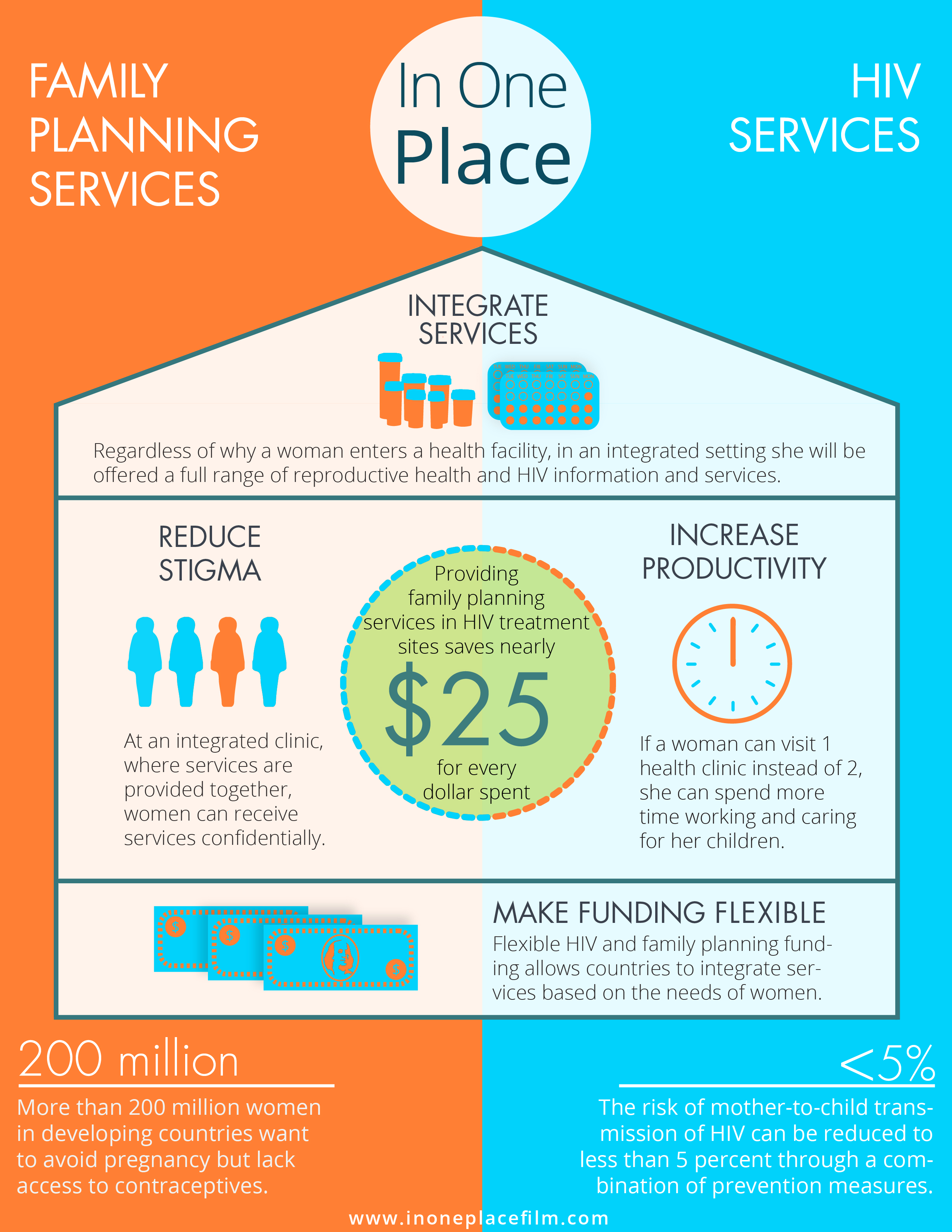
Some pretty great research is cropping up at the 2012 International AIDS Conference, and it’s hard to pick just one finding to reference, but I do love infographics and I do love family planning – so I found something that combines the two! Population Action International, a truly fantastic research and advocacy organization focused on women’s reproductive health access and care, and they make a great point about the advantages and importance of providing both family planning and HIV services at the same time and in the same place. They point out that mother-to-child HIV transmission can be reduced, stigma may decrease, and both time and money are save. Take a look:

Combining HIV and family planning services (courtesy of Population Action International).

Another issue at hand is that of the relationship between a provider and a patient or client. Family planning clinics have a better chance of establishing long-term relationships with women – particularly if women have multiple children – given that they also sometimes aid in pre- and post-natal care or help connect women to those services, which increases the likelihood of women who test HIV+ to getting the treatment they need. Again, all in one place!

Follow along at #AIDS2012 on Twitter to stay abreast of everything going on in D.C.

Maternal Health and the Status of Women

Both globally and domestically, maternal health and the standing of women are inextricably linked. If women do not have the means and access to give birth safely, with trained and educated midwives, physicians and nurses, with appropriate prenatal education and care, it is often indicative of the standing of women in their communities and countries overall. Women’s inequality is also linked to the soaring population growth in developing countries, which will pose a range of new challenges for the next few generations.

Some may point to the United States as an anomaly, citing women’s increasing economic and financial independence, education, and leadership roles in America, while in terms of maternal health rankings, we remain pathetically far down the line for our resources (49 other countries are safer places to give birth than the U.S. – despite us spending more money on healthcare than anywhere else). Of course, the recent and incessant attacks on allowing women to access credible, accurate, up-to-date and comprehensive sexual and reproductive health education and services makes this statistic not entirely…surprising, shall we say.

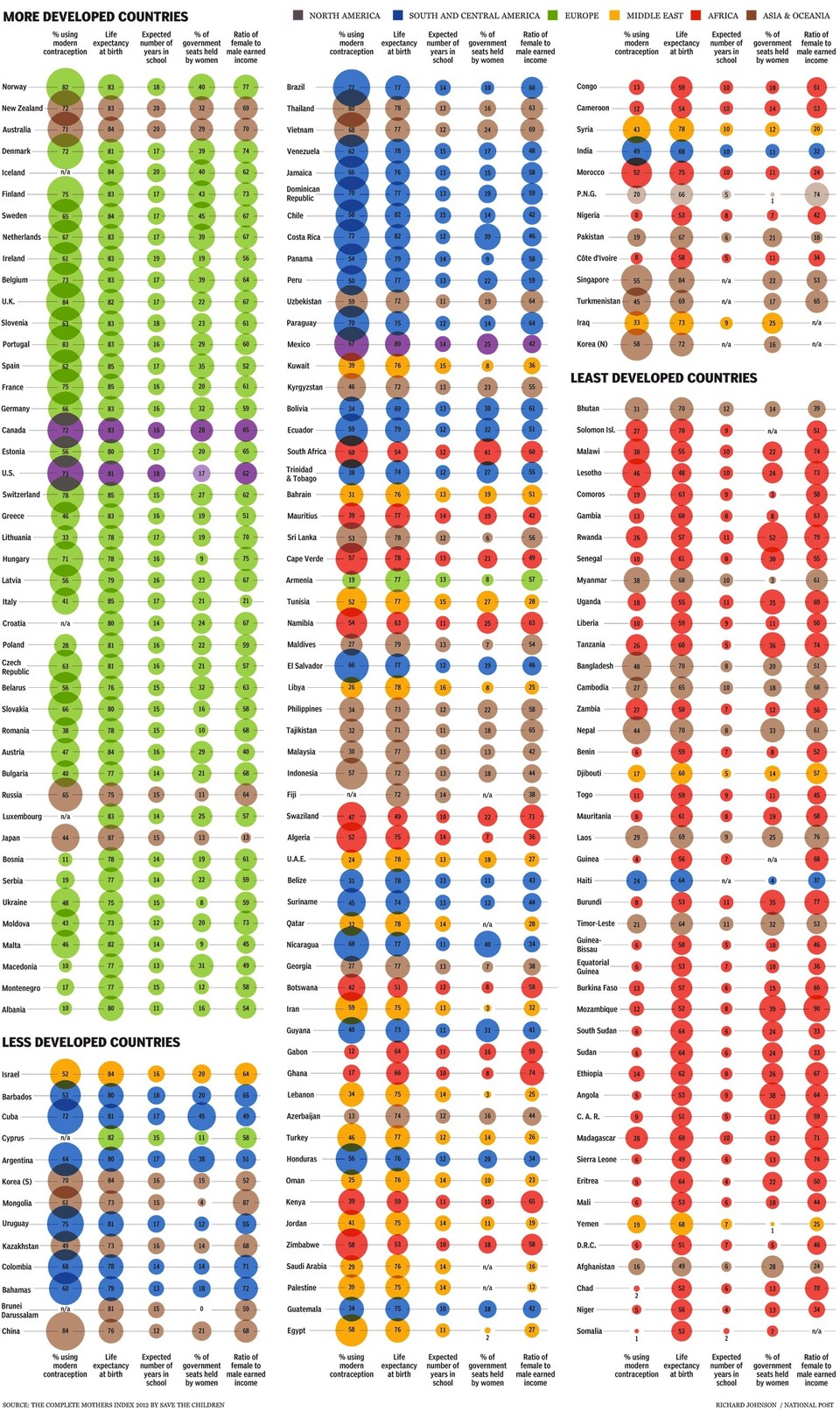
So, I found the incredibly detailed and visually impressive infographic by the National Post, pulled from spectacular data and research done by Save the Children to be particularly fascinating. What they did was combine information on the health, economic, and education status of women to create overall rankings of the best and worst countries for women, splitting the countries into categories of more developed, less developed, and least developed, and the countries were ranked in relation to the other countries in their category (the divisions were based on the 2008 United Nations Population Division’s World Population Prospects, which most recently no longer classified based on development standing). While these divisions and the rankings can certainly be contentious and may incite some disagreement (nothing unusual there, these kind of rankings usually are), I thought the results were interesting. Some highlights – Norway is first, Somalia is last. The United States was 19th, and Canada was 17th (Estonia fell in between us and the Great White North) in the most developed. Israel is first in the less developed category, and Bhutan is first in the least developed category. The full report with data from Save the Children is also available, if you want to learn more about the information combined to make this image. Take a look:

A Woman’s Place – Courtesy of the National Post

One thing that I thought was particularly great was that the researchers combined women’s health and children’s heath data to create rankings specific to being a mother, when that category is sometimes only assessed based on access to reproductive care.The specific rankings of maternal health highlights largely mimics the overall standing of women, as seen here – Norway is number one, again, and Niger falls into last place:

Mother’s Index, Courtesy of Save the Children

I think these images and graphs are particularly moving given one of the top health stories coming out of the New York Times today, which showed that a recent Johns Hopkins study indicated meeting the contraception needs of women in developing countries could reduce maternal mortality (and thereby increase the standing of women in many of the nations doing poorly in the above ranking) globally by a third. When looking at the countries in the infographic that have low rates of using modern contraception and the correlation between that and their ranking in terms of status of women, it’s not surprising what the JH researchers found. Many of the countries farther down in the rankings have rates below 50%, and for those countries filling the bottom 25 slots, none of them even reach a rate that is a third of the population in terms of contraceptive use – which of course in most cases has to do with availability, not choice. Wonderfully, the Gates Foundation yesterday announced that they would be donating $1 billion to increase the access to contraceptives in developing countries.

Also of note, and in relation to maternal and newborn health, is a new study recently published by Mailman researchers that showed PEPFAR funded programs in sub-Saharan Africa increased access to healthcare facilities for women (particularly important for this region, as 50% of maternal deaths occur there), thereby increasing the number of births occurring in these facilities – reducing the avoidable (and sometimes inevitable) complications from labor and delivery, decreasing the chance of infection and increasing treatment if contracted. This has clear implications for children as well (and why I think this study relates to the National Post infographic and the NY Times article), since newborns are also able to be assessed by trained healthcare workers and potentially life-threatening conditions averted – including HIV, if the newborns have HIV+ mothers and need early anti-retroviral treatment and a relationship with a healthcare worker and system. And it goes without saying that if a new mother is struggling with post-delivery healthcare issues, including abscesses and fistulas, or was dealing with a high-risk pre-labor condition like preeclampsia, the child will have an increasingly difficult early life, perhaps even a motherless one.

Social Media Continues to Make People Feel Bad About Themselves

A study out of the UK has found (as have others more than once), that use of social media sometimes doesn’t make you feel like…really socializing. Rather, it can make you feel anxious and depressed.

The study found that participants noted a drop in their own self-esteem after viewing the accomplishments of their Facebook friends. Combine this with the fact that 25% of them claimed to have had relationship issues due to online ‘confrontations’ (which could, of course, mean many things), that more than half were rendered uncomfortable when they couldn’t easily access their social media accounts, that other studies have claimed more socially aggressive (subtly termed ‘hateful’) folks use Facebook more often, that people often deliberately post bad pictures of their friends to make themselves look better and subsequently compare their weight, body size, and physical appearance to these friends, and that Facebook is cited in divorce proceedings as being problematic for couples, and you may be liable to think that this phenomenon offer little in the way of improving our lives.

A good thing to remember here, aside from the pretty remarkable things being done with social media in terms of education, research, medicine, and public health (this USC study is great news, and touches upon the influence of social networks in ways I’ve been exploring as it relates to substance use, sexual behavior, and disordered eating behaviors, and that other studies have shown the exact opposite in terms of emotional response, is that social media does allow users to tailor the perception and identity they project. Another recent study (I’ll try to find the URL for it!) showed, unsurprisingly, that what users often admire about their friends’ virtual lives is the positive sliver that their friends elect to promote about themselves.

Also encouragingly, those children and adolescents who will have known no life without social media, recently were surveyed about their use of technology and reported that they still preferred face-to-face communication. I put limits on myself in terms of use (though I’m sure to some of you it may not seem like it!) since I feel as though I miss a lot in terms of nuance when communication online, but it remains true that both my research and personal communication projects require a fairly consistent social media presence – I admit that I’m torn. As with most everything, balance is key, but how can we monitor our behavior in ways that allow us to strike that balance without teetering into territory that destroys our positive sense of self?

Thoughts? How about you ironically follow me on Twitter to discuss?

Child Mortality – What Are the True Biggest Causes?

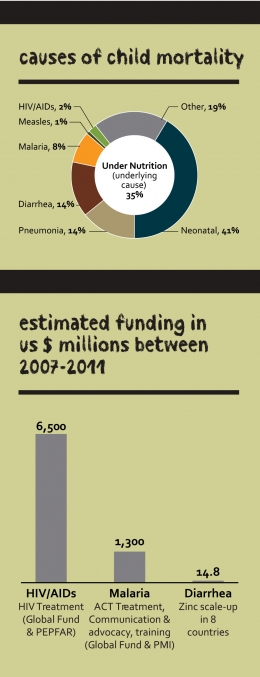
A great image from Population Services International‘s most recent issue of their magazine, Impact, from the cover article written by Desmond Chavasse, Ph.D, Vice President, Malaria Control & Child Survival, PSI, about causes of child mortality globally.

Causes of Child Mortality – Image courtesy of Population Services International

One of the purposes of the image, of course, is to show the stark contrast between directed funding for treatment and eradication of certain diseases and the number of children afflicted with these illnesses. How does this impact our understanding of global health and of the marketing around certain hot topic health issues and ways in which donors feel as though they are contributing to a decline in preventable deaths?

When I worked in development for HIV/AIDS organizations, it was fascinating to speak with donors about their reasons for giving and their understanding of the prevalence and incidence (and the general audience grasp of the word incidence, which is the measure of risk of contracting a certain illness or disease within a specified time frame) of HIV. Contrast this with the understanding of malaria, TB, diarrhea, deaths due to childbirth complications (for the mother and the infant), and the gap between perception and reality was startling. In no way do I want to deny the importance of consistent development support for all diseases on a global scale, but I do think there is something lacking in terms of the education around these issues for donors and even some advocates.

Solutions? Come chat with me on Twitter.

Is This Real Life? The Reproductive Rights Version

My support of a woman’s right to choose is well-documented. I champion a woman’s freedom to make a decision about whether or not she should be carrying a fetus, and the availability of resources for her to safely and quickly terminate a pregnancy if she sees fit.

We are in  troubled times. Ceaseless efforts to deny women these rights are abound, and I could link to hundreds of articles that document this, but the handful I’ve chosen certainly upset me enough. I, along with scores of women’s health advocates, have tried any number of measurable ways to fight back – raising more money; drafting opposing legislation and striking down initiatives; testifying before hearings; writing op-ed pieces that detail our positions and rationally lay out the reasons why these reproductive rights are essential to women’s health, well-being, and even economic prospects; explaining that abortions and contraception are also necessary for reasons far beyond prevention pregnancy, and that all reasons are valid and worthwhile.

We’ve been insulted, condescended to, systematically stripped of essential healthcare resources.

I’m tired. I’m tired of the hypocrisy of the anti-choice wing. Tired of the false rhetoric. Tired of their offensively misguided and false claims to care about women as much as they care about fetuses, tired of the aggressive push to force women to maintain pregnancies that they are unprepared for and do not want, and further impact their educational and economic statuses. Tired of the trumpeting of false information about contraception that is subsequently followed up by happily taking money from the very creators of products that prompted their supposed moral outrage. Tired of their total disregard of the reality of many of these women who make the decision to have an abortion. Tired of total disregard of the statistics that undermine their arguments about the United States valuing children and their yet-to-be-realized lives. Tired of the total disregard and dismissal of real ways that abortions could be prevented – complete and comprehensive sexual health education and easy access to a variety of contraceptives. Tired of the complete disdain for women as sexually independent beings, tired of their disgust of the sexual lives of women while giving men and their sperm an unlimited free pass and the ability to impregnate and take off without even a slap on the wrist. Tired of the inability to empathize and simultaneously mete out punishments to the half of the population they deem fit the ostensible crime of engaging in sexual activity. If you want to harp on the issue of responsibility, then it is essential to ensure that both parties are equally responsible in every way – and as about half of the links I have put in this post show, that simply does not happen. Women are disproportionately – vastly so – shouldered with the entire burden of and the entire blame. That’s the reality, and it can’t be separated from the issue.

I’m tired but not worn out. I remain entirely committed to this cause, and won’t be sidetracked by opponents who use everything from personal insults to false science to shaky numbers to try to distract me. Nancy Keenan, the president of NARAL, recently announced that she is stepping down – largely due to the fact that she feels millennials need to begin steering the abortion rights ship, to combat the intense dedication of anti-abortion activists. Over 50% of anti-choicers maintain that abortion is a primary issue for them in elections, while only about a quarter of pro-choicers say the same. Well, I’m here. This remains my number one issue. Are you with me?

A friend recently sent me yet another HuffPo article, that I certainly enjoyed, but that for some reason was the straw that broke my camel’s back in many ways, as I saw her argument struggling mightily to encompass all of the above reasons why we should protect contraceptive access for all women. I’m so tired, in fact, that my response to these attacks has been harrowingly brought down to the essential core that I never thought I would need to stray from when I first realized what being pro-choice was; stripped of the attempts to rationalize (issues of medical necessity outside of pregnancy prevention aside, issues of risk to the mother aside, issues of childcare concerns and education concerns aside) with those who are, in fact, irrational about these issues. What happens in my uterus is my business alone. If you want the babies that these fetuses become, that women made the decision they cannot care for, then there should be no difficulty in deciding that you should take them. Take them all. Take them lovingly and fully, not cynically or begrudgingly. Cultivate them for 9 months, care for the baby when it’s born, love her, feed him, clothe her, educate him, without any help from me. If your goal is to punish women who you think have made flagrantly immoral mistakes, let us air all of your dirty laundry as well, and dissect every single decision you in your life made, and force you to pay for it as we see fit. And by all means, find a way to keep the men who didn’t use condoms, or bullied their partners into not using contraception and subsequently fled, or who threatened or coerced their partner, sitting firmly next to a baby’s crib. Come up with solutions to the myriad of complex social and economic issues that contribute to reasons women get abortions. Re-educate yourself on the fundamental fact that it is not your right to dictate the decisions of another person, and while that lack of control may infuriate you, it’s the way it is.  What happens in my uterus is my business alone. Wherever I go, the uterus goes. You don’t get to stake your judgment flag in my sex organs selectively at will, running “protectively” towards it when it suits you, and fleeing from it (and from what it carries) when it doesn’t. You don’t get to be there at all!

So don’t tell me that we have a collective duty to care for these unborn babies when what you are actually doing is attempting to control the freedom of women while doing everything you can to make sure that no true collectivism actually does benefit women or their babies.

Why Doctors Think mHealth Will Cut Down on Doctor’s Visits

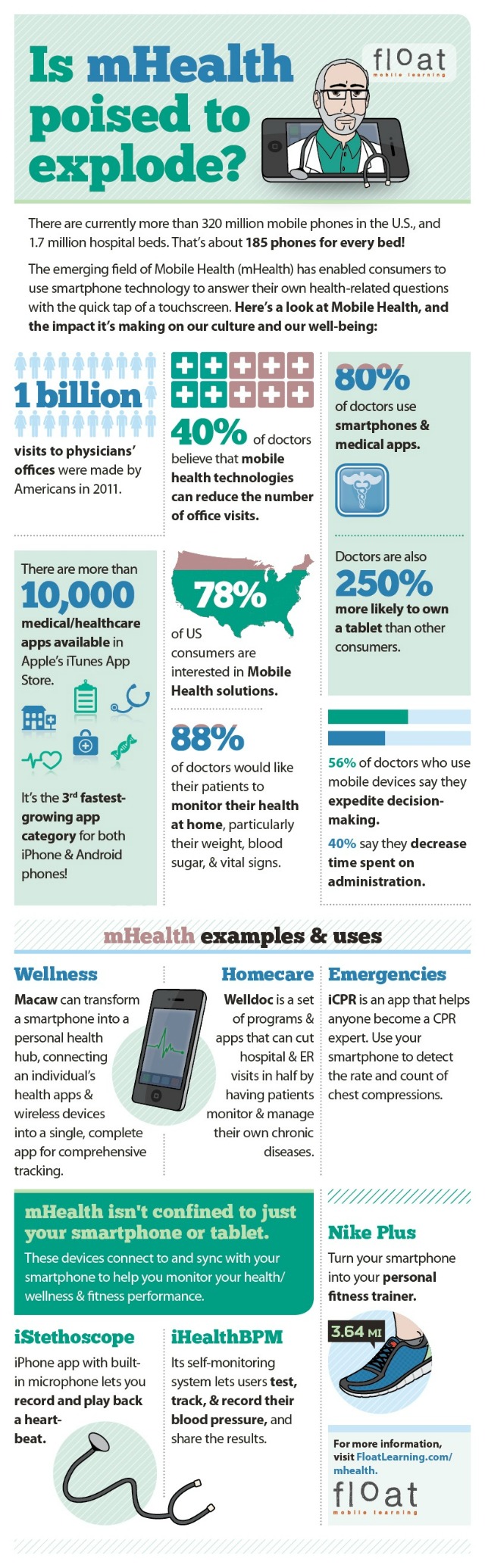
This is a great infographic, courtesy of Mashable, that details the vareity of ways mobile health improves patient outcomes and an individual’s ability to manage their preventitive behavior on their own. It’s a pretty robust outline:

Shame Won’t Make You Healthy. Really.

Some of you public health and social marketing gurus have likely already come across the recent slew of ads in Georgia, published by an organization called Strong4Life, that are ostensibly part of an effort to curb childhood obesity. A lofty goal, indeed, but a misguided approach, the criticisms of which have already begun. The images are pictures of overweight and obese children with a variety of captions, including “It’s hard to be a little girl if you’re not,” and “Fat may be funny to you, but it’s killing me,” and “Fat prevention begins at home. And the buffet line.”

Shaming rarely works as a strategy for behavior change. It’s been shown in efforts ranging from drug use behavior to HIV-prevention goals and marketing campaigns. If you click on the images in the Strong4Life campaign you get taken to video spots of these children, who seem burdened by sadness and depression (which can be both causes of and side effects of being overweight – exacerbating these emotional states does not help in weight loss endeavors). Recognizing if one is at an unhealthy weight is an essential step towards healthy weight loss, but the children do not appear buoyed by information, support, and new ideas on ways to be healthy. They seem downtrodden and embarrassed, the very characteristics that a shaming and body-bullying culture easily pounce on and cultivate. The video of Bobby, which portrays a mother who appears shamed by her son’s question doesn’t make me want to hit the gym or eat a platter of vegetables. Instead, the voyeuristic quality of the mock confessions feels more than a bit exploitative and it triggers a gut reaction of sympathy and protectiveness, making me want to yank the camera from the hands of Strong4Life. It’s like they took a message from the Jillian Michaels’ school of adding insult to injury, splashing in an additional dose of fear and intimidation, and expecting that this will result in a lifelong substantial increase in meaningful self-esteem.

The well-developed criticisms of this campaign point out that not only does shaming and negative marketing not induce healthy behavior change, but that these ads do nothing educationally. One girl near-tearfully admits that she gets made fun of at school because she’s fat, and the video slams down a tag line of “being fat takes all the fun out of being a kid” before fading out. While the Strong4Life campaign has a “Get Started” tab offering facts about nutrition and screen time and physical activity, the impact of the original image has already been made. Advertising relies on quick one-liners, on stark imagery, and emotional reactions. In this case, what we see is a tag line reiterating that this girl is not a normal kid, a solitary image of an overweight girl connected to an emotional plea on her part of loneliness and victimization. It’s powerful all right, but not empowering. The ad emphasizes fat loss, heightening the importance placed on size, instead of cultivating an interest in healthy lifestyles and appreciation of the fact that people come in different sizes and can be equally healthy. Critics of the appreciation-of-all-sizes approach say it borders on supporting obesity, which I see as short-sighted. Very high weight status can certainly indicate other problems, like diabetes, early heart and respiratory problems, and difficulties engaging in physical activity. But it’s also essential to make sure that the message that larger sizes are universally unhealthy is quashed, and it’s vital to promote instead that appreciating people of all sizes is essential – and more importantly, that valuing people regardless of size is a priority. This is a topic that deserves that kind of nuance.  I would welcome ads that excitedly show kids engaging in active lifestyles, enjoying sports and enjoying healthy, full diets – creating characters in ads that viewers want to emulate, as opposed to characters that viewers are meant to distance themselves from or who are meant to be repelling, is not only good business sense but inclusive and supportive. These ads further emphasize and underscore the cultural norm categories of “normal weight kids are normal” and “overweight kids are not normal and therefore not ok” – this certainly won’t help curb teasing or bullying in this arena. And since we do know that consistent, positive social support is one of the key factors in healthy behavior change, it’s obvious why public health experts met this series with skepticism. And here’s what else we know – healthy lifestyle changes significantly decrease mortality, regardless of baseline body mass index. Changes in fitness level are what alter all-cause mortality, not changes in BMI.

The response that these ads are cultivating “important conversation” is somewhat moot. It may get people talking, and it hopefully it will encourage media platforms with a larger audience than this blog to come out with constructive, evidence-based, supportive tips and strategies for a healthy lifestyle – but the fact remains that these ads are contributing to the negative, body-shaming noise that fuels so much of popular media and it remains that the effect can be really damaging and counter-productive at the outset. Individuals who ultimately are successful at losing large amounts of unhealthy weight (or who more consistently use condoms, for example) do so not merely because someone called them fat (or because they knew someone who became infected with HIV) – this has happened many times over to individuals seeking or needing to enact behavior change. The change happens because they not only begin to see themselves as deserving of these changes, but also because they become helpfully informed with concrete action steps that help move them through behavior change, are supported and consistently cheered on, and because they know what to do if they feel themselves slipping.

The bottom line is that discussions about healthy living need to happen to prevent long-term chronic health problems, and these conversations do need to happen early. But they shouldn’t start with shaming, embarrassment, or the putting on display of children who have weight problems and asking them to broadcast what’s so horrible about it while telling them that their love of the buffet is what got them to this point. We can do better.

Sebelius Caves, Girls Pay the Price

By now, I’m sure you’ve all heard that Kathleen Sebelius, the Secretary of Health and Human Services, has blocked the recommendation of the Food and Drug Administration that the over the counter (OTC) drug Plan B, commonly known as the ‘morning after pill,’ be made available without a prescription for girls of all ages. It is currently available without a prescription to girls ages 17 and up, and requires a prescription for girls ages 16 and below.

It is worth noting that this is the first time a Secretary of HHS has overruled the FDA. This is not insignificant. The purpose of HHS is to promote the health, safety, and well-being of Americans. The FDA is an obvious component of this. While the FDA is an agency of HHS, the purpose of the FDA is to promote and protect public health, through the regulation of OTC and prescription medications, vaccines, food safety, medical devices, and more. They do this through clinical trials and testing, which is how we come to know of drugs’ side effects as well as how significantly they aid in the relief of what they purport to treat. The FDA recruits researchers who understand both the purpose of and execution of this research. Attempts have been made to loosen the regulations of the FDA; for example, some terminally ill patients have petitioned the FDA to allow them to access experimental drugs after Phase I of a trial – the FDA has denied these requests due to the lack of research regarding a drug’s long-term effects post- Phase I. The FDA is not without criticisms; they have been accused of being both too hard and too lax on the pharmaceutical industry. Members of the FDA have also expressed feeling pushed to present certain results. Scientists at the FDA complained to Obama in 2009 that they felt pressured under the Bush administration to manipulate data for certain devices, and the Institute of Medicine also appealed for greater independence of the FDA from the powers of political management.

The commissioner of the FDA, who is a physician, reports to the Secretary of HHS. Sebelius’ job is not one of medicine or research, and requires a background in neither. It does require a background in politicking, which is exactly what we’re seeing here. The purpose of pointing that out, and of articulating that this is the first time a Secretary of HHS has overruled an FDA recommendation, is that Sebelius’ refute would not be based on differing scientific results, or research that opposes the FDA’s recommendations – because there is none. The override has different drivers, and the assumption floating out there – for good reason, since there is little alternate explanation – is to appease social conservatives and the anti-abortion contingents.

Plan B is not the abortion pill. It is the equivalent of an increased dose of a daily birth-control pill, and has no effect on already established pregnancies – it prevents pregnancy from occurring. Scientists within the FDA unanimously approved the access of the drug without a prescription for girls of all ages, after an expert panel put the recommendation forward. It is, to quote a USC pharmacist, one of few drugs that is so “simple, convenient, and safe.”

The conservative Family Research Council claims that requiring a prescription will protect girls from sexual exploitation and abuse – I fail to see how requiring a girl to get a prescription will protect against sexual violence, especially since girls may be attempting to get Plan B because sexual violence has already occurred. This comment is also a flagrant indication of misunderstanding of sexual violence and abuse – a young girl is not likely to disclose to an unknown physician that she is being sexually abused or assaulted and that’s why she needs a prescription for Plan B. Make no mistake, this ban is a victory for anti-abortion rights activists. If a girl cannot prevent a pregnancy from occurring, she is subsequently faced with trying to terminate an existing pregnancy (again – that could have been prevented!). Given how reproductive and abortion rights have been systematically chipped away at for the past few years, this girl who did not want the pregnancy and tried to prevent it from happening but was denied because she is shy of 17 years, will be in an even worse position. This is what anti-abortion activists are counting on – that once she is pregnant she will have to carry to term.

Plan B can prevent abortions from happening. HHS, with its mission of protecting the health and welfare of all citizens, should do everything they can to protect the health of girls’ reproductive development, which includes the prevention of unwanted pregnancy at its earliest stage. The girls under the age of 17 who need Plan B the most are the ones who also need it to be as easily accessible as possible. Much like requiring parental permission for abortions for girls under the age of 18, this ban actually can put girls at risk. Many girls will not have the family support, financial means, or healthcare to manage a pregnancy; some girls may face parental and familial abuse if they have to admit to needing to prevent a pregnancy with Plan B. What if a girl is a victim of sexual assault within her family? Should she be forced to deal not only with this trauma, but also have to determine how to prevent herself from being forced to carry a fetus to term as a result of this tragedy? Most girls under the age of 17 do not have easy access to clinicians and hospitals on their own, nor are they able to navigate our increasingly complex healthcare system on their own, which they would not only need to do to access Plan B, but would need to do within 72 hours for the pill to be effective. Girls whose bodies are not ready for pregnancy, girls who were victims of assault and rape and incest, girls whose futures will be dramatically changed and opportunities truncated – they all become casualties of this ban. Before we start sex-shaming and proclaiming that they shouldn’t have had sex if they didn’t want to deal with the consequences, let’s remember that these girls were not miraculously impregnated. Whether consensual or not, a boy was involved. This is a gendered issue – the girls are the ones who will have to deal with the lack of access to Plan B, physically, mentally, and emotionally.

Originally, advocates in 2003 successfully petitioned Plan B to be available OTC for girls 18 and up (after having been available with a prescription since 1999), but a judge overruled that decision and lowered the age to 17 after he deemed the decision had been made politically, not for scientific reasons. It appears that history is repeating itself.