Child Mortality – What Are the True Biggest Causes?

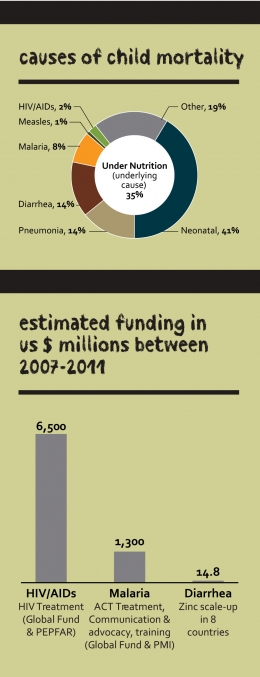
A great image from Population Services International‘s most recent issue of their magazine, Impact, from the cover article written by Desmond Chavasse, Ph.D, Vice President, Malaria Control & Child Survival, PSI, about causes of child mortality globally.

Causes of Child Mortality – Image courtesy of Population Services International

One of the purposes of the image, of course, is to show the stark contrast between directed funding for treatment and eradication of certain diseases and the number of children afflicted with these illnesses. How does this impact our understanding of global health and of the marketing around certain hot topic health issues and ways in which donors feel as though they are contributing to a decline in preventable deaths?

When I worked in development for HIV/AIDS organizations, it was fascinating to speak with donors about their reasons for giving and their understanding of the prevalence and incidence (and the general audience grasp of the word incidence, which is the measure of risk of contracting a certain illness or disease within a specified time frame) of HIV. Contrast this with the understanding of malaria, TB, diarrhea, deaths due to childbirth complications (for the mother and the infant), and the gap between perception and reality was startling. In no way do I want to deny the importance of consistent development support for all diseases on a global scale, but I do think there is something lacking in terms of the education around these issues for donors and even some advocates.

Solutions? Come chat with me on Twitter.

Conservatives Win the Healthcare Messaging War

For many left-leaning Americans, little is more important aside from the state of the economy right now than healthcare reform – and they’re inextricably linked. Coverage of healthcare reform is pretty high this week, with the expectation that the Supreme Court will hand down their decision regarding the constitutionality of the Affordable Care Act this Thursday. This hasn’t always been the case.

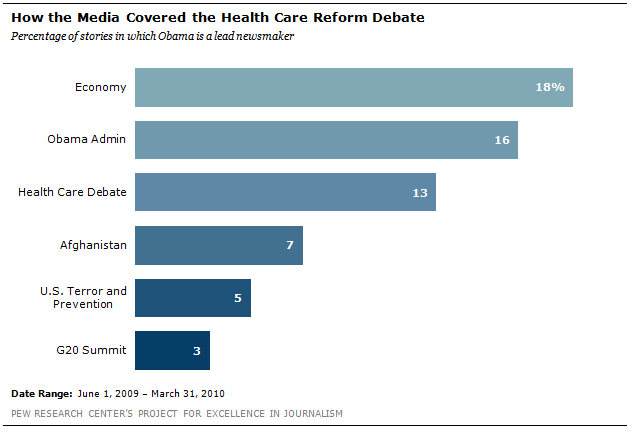
Interestingly, while this is being considered a flagship of the Obama Administration, in his first year as President, healthcare reform ranked third in terms of media coverage mentioning Obama:

Media Coverage of Stories Featuring Obama in First Year of Term – Courtesy of PEW Research Center

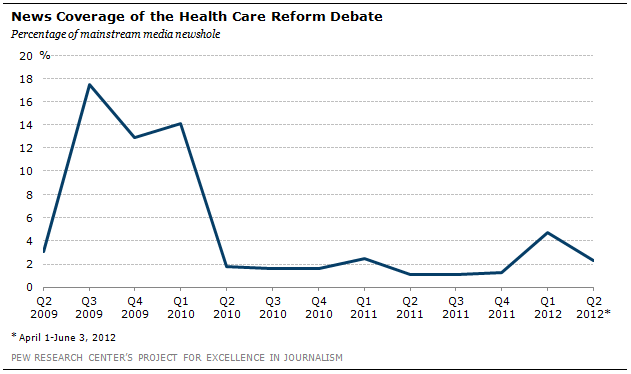
One would think that covering healthcare reform – and specifically, the details of the Affordable Care Act, and what the law really means – would be imperative after the passing of the ACA. Ensuring that the law was really understood by citizens would seem to be fairly essential, but what happened instead was a decline in media coverage of HCR after Obama’s first year as President – as shown by the Pew Research Center:

HCR Coverage Over Presidency – Courtesy of PEW Research Center

So what does that mean? If coverage goes down, and little has been done to ensure that people truly understand the law (for example, understand what the mandate really means, and what the implications are if it is struck down, which was recently elegantly laid out by the NY Times), the short messaging around the issue becomes even more important.

Cable news can be inflammatory, reactionary, harsh, exaggerated, and at times, unsurprisingly infuriating. They often preach to their respective choirs on the political spectrum, and because of this, I worry that they’ve become so comfortable with their audience that the arguments aren’t as sharp, or clear, as they could be. The brief messaging lacks context and nuance, and headlines or key phrases can substitute for deep understanding of one’s understanding of an issue (and taking today’s ruling on the Arizona immigration law, one can see how brief messaging can create some confusion – one headline read that SCOTUS struck down three components of the immigration law, and the next one I saw trumpeted that SCOTUS had upheld a key component of the immigration law – both were true, neither were particularly informative)

In the context of the fight for comprehensive health care, conservatives seem to have won this messaging game. The new study from the Pew Research Center shows that while liberal talk shows spent more time talking about healthcare reform –

Liberal Versus Conservative Talk Show HCR Coverage – Courtesy of PEW Research Center

– certain select terms used by healthcare reform opponents that really emphasized negativity were used at rates nearly twice that of terms used by supporters that underscored positive elements of healthcare reform:

Terms Used in HCR Debate – Courtesy of PEW Research Center

Take a look at these terms – which would you say were more compelling? Phrases that would incite more visceral, gut reactions from listeners? I can see how “insuring pre-existing conditions” would actually appeal to both sides, but this barely stood a chance against “more taxes with health care reform” which was mentioned nearly twice as many times and can certainly appeal to the financial fears of viewers. “More competition” would seem to appeal to many free-market espousing conservatives, but is trumped by “more government involvement,” which is the base fear of many Republicans. “Rationing health care” just isn’t true, but instead of rebutting that with facts about the law, HCR supporters shot back with “greedy insurance industry,” which likely wouldn’t win over any opponents to the law, who can claim that insurance agencies are just businesses, trying to capitalize on profits. And that’s where I think the HCR supporters had an in that they didn’t take – commenting on the prioritization of profits for a specific industry over the health of our communities and country as a whole.

Is the assumption that compassion is not an effective communication tool? If so, why is that? I find myself deeply moved by stories of people who are in desperate need of health care but lack the resources – insurance, financial, proximity to quality affordable careĀ  – to get it. And I’m certain that I’m not the only one. New York Magazine today touched on the alarming fact that the moral argument – the empathetic position, the community cares idea, the position that healthcare is a fundamental human right – has been remarkably absent from the healthcare debate. I fear that it mostly plays into the uniquely American mentality that regardless of circumstance, each individual has to be able to fend for themselves. While this concept underscores certain types of resiliency and determination that are I think are overly-admired, the fact of the matter is that disregarding the circumstances is not possible. Disregarding the impact of staggering inequality of access to care and financial resources is short-sighted and, more importantly, I would say rather cruel.

If the discussions had focused more on why everyone deserves healthcare – why everyone deserves to be treated with dignity, receive comprehensive care, understand how to care for themselves – since healthcare is an essential component of our right to life (not to mention the pursuit of happiness), would the results have been different? If we appealed to our humanity and illustrated the absurdity of someone dying from a treatable illness, when people who could have helped them essentially stood by just because…they didn’t have any money? Because that’s essentially what this is – the inability to personally protect oneself and one’s family because of dearth of resources. If we had made it more personal, and less political? If we focused less on the greedy agencies, the so-called rationing of care, the increased business competition, if we had actually responded to the claim of too much government intrusion with the response that the government should in fact be intervening when doing so can save the lives of its citizens? Does the punishment of death really fit the ‘crime’ of not getting oneself health insurance, if one was not able to do so because they couldn’t afford it?

Is that the legacy we want to leave?

Is This Real Life? The Reproductive Rights Version

My support of a woman’s right to choose isĀ well-documented. I champion a woman’s freedom to make a decision about whether or not she should be carrying a fetus, and the availability of resources for her to safely and quickly terminate a pregnancy if she sees fit.

We are inĀ  troubled times. Ceaseless efforts to deny women these rights are abound, and I could link to hundreds of articles that document this, but the handful I’ve chosen certainly upset me enough. I, along with scores of women’s health advocates, have tried any number of measurable ways to fight back – raising more money; drafting opposing legislation and striking down initiatives; testifying before hearings; writing op-ed pieces that detail our positions and rationally lay out the reasons why these reproductive rights are essential to women’s health, well-being, and even economic prospects; explaining that abortions and contraception are also necessary for reasons far beyond prevention pregnancy, and that all reasons are valid and worthwhile.

We’ve been insulted, condescended to, systematically stripped of essential healthcare resources.

I’m tired. I’m tired of the hypocrisy of the anti-choice wing. Tired of the false rhetoric. Tired of their offensively misguided and false claims to care about women as much as they care about fetuses, tired of the aggressive push to force women to maintain pregnancies that they are unprepared for and do not want, and further impact their educational and economic statuses. Tired of the trumpeting of false information about contraception that is subsequently followed up by happily taking money from the very creators of products that prompted their supposed moral outrage. Tired of their total disregard of the reality of many of these women who make the decision to have an abortion. Tired of total disregard of the statistics that undermine their arguments about the United States valuing children and their yet-to-be-realized lives. Tired of the total disregard and dismissal of real ways that abortions could be prevented – complete and comprehensive sexual health education and easy access to a variety of contraceptives. Tired of theĀ complete disdain for women as sexuallyĀ independent beings, tired of their disgustĀ of the sexual lives of women while giving menĀ and their sperm an unlimited free pass and the ability to impregnate and take offĀ without even a slap on the wrist. Tired of the inability to empathize and simultaneously mete out punishments toĀ the half of the populationĀ they deem fit the ostensible crimeĀ of engaging inĀ sexual activity. If you want to harp on the issue of responsibility, then it is essential to ensure that both parties are equally responsible in every way – and as about half of the links I have put in this post show, that simply does not happen. Women are disproportionately – vastly so – shouldered with the entire burden of and the entire blame. That’s the reality, and it can’t be separated from the issue.

I’m tired but not worn out. I remain entirely committed to this cause, and won’t be sidetracked by opponents who use everything from personal insults to false science to shaky numbers to try to distract me. Nancy Keenan, the president of NARAL, recently announced that she is stepping down – largely due to the fact that she feels millennials need to begin steering the abortion rights ship, to combat the intense dedication of anti-abortion activists. Over 50% of anti-choicers maintain that abortion is a primary issue for them in elections, while only about a quarter of pro-choicers say the same. Well, I’m here. This remains my number one issue. Are you with me?

A friend recently sent me yet another HuffPoĀ article, that I certainly enjoyed, but that for some reason was the straw that broke my camel’s back in many ways, asĀ I saw her argument struggling mightily to encompass all of the above reasons why we should protect contraceptive access for all women. I’m so tired, in fact, that my response to these attacks has been harrowingly brought down toĀ the essential core that I never thought I would need to stray from when I first realized what being pro-choice was; stripped of the attempts to rationalize (issues of medical necessity outside of pregnancy prevention aside, issues of risk to the mother aside, issues of childcare concerns and education concerns aside) with those whoĀ are, in fact,Ā irrational about these issues. What happens in my uterus is my business alone. If you want the babies that these fetuses become, that women made the decision they cannot care for, then there should be no difficulty in deciding that you should take them. Take them all. Take them lovingly and fully, not cynically or begrudgingly. Cultivate them for 9 months, care for the baby when it’s born, love her, feed him, clothe her, educate him, without any help from me. If your goal is to punish women who you think have made flagrantly immoral mistakes, let us air all of your dirty laundry as well, and dissect every single decision you in your life made, and force you to pay for it as we see fit. And by all means, find a way to keepĀ the men who didn’t use condoms, or bullied their partners into not using contraception and subsequently fled, or who threatened or coerced their partner, sitting firmly next to a baby’s crib. Come up with solutions to the myriad of complex social and economic issues that contribute to reasons women get abortions. Re-educate yourself on the fundamental fact that it is not your right to dictate the decisions of another person, and while that lack of control may infuriate you, it’s the way it is.Ā  What happens in my uterus is my business alone.Ā Wherever I go, the uterus goes. You don’t get to stake your judgment flag in myĀ sex organs selectively at will,Ā runningĀ “protectively” towards itĀ when it suitsĀ you, and fleeing from itĀ (andĀ from what it carries)Ā when it doesn’t. You don’t get to be there at all!

So don’t tell me that we have a collective duty to care for these unborn babies when what you are actually doing is attempting to control the freedom of women while doing everything you can to make sure that no true collectivism actually does benefit women or their babies.

Why Doctors Think mHealth Will Cut Down on Doctor’s Visits

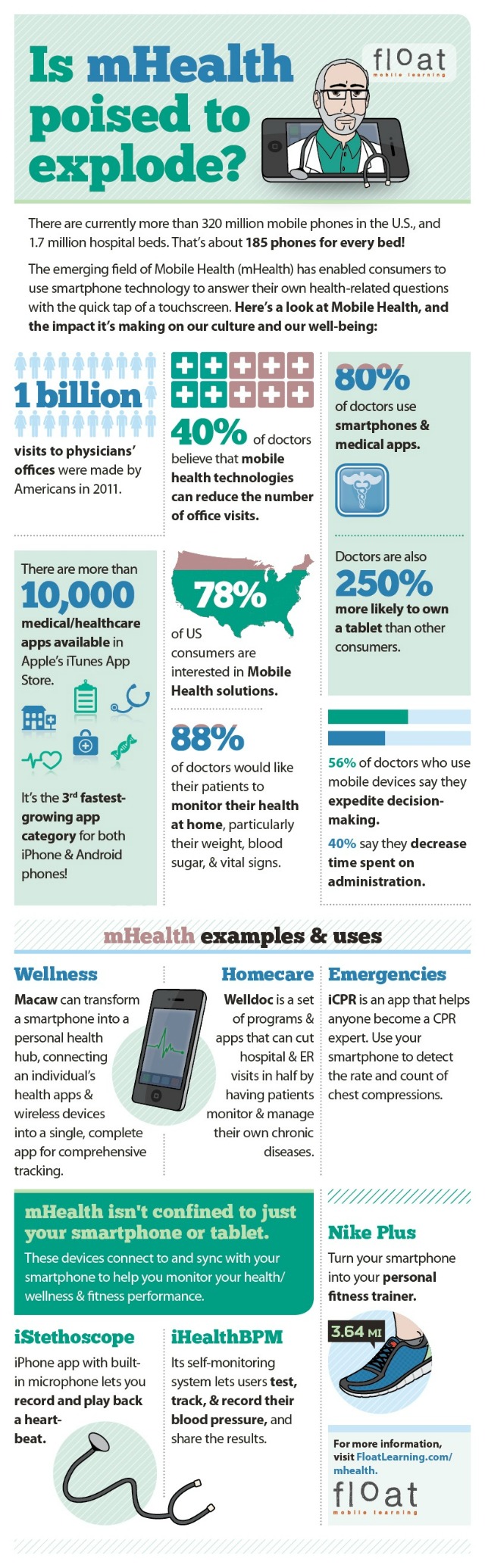
This is a great infographic, courtesy of Mashable, that details the vareity of ways mobile health improves patient outcomes and an individual’s ability to manage their preventitive behavior on their own. It’s a pretty robust outline:

Sebelius Caves, Girls Pay the Price

By now, I’m sure you’ve all heard that Kathleen Sebelius, the Secretary of Health and Human Services, has blocked the recommendation of the Food and Drug Administration that the over the counter (OTC) drug Plan B, commonly known as the ‘morning after pill,’ be made available without a prescription for girls of all ages. It is currently available without a prescription to girls ages 17 and up, and requires a prescription for girls ages 16 and below.

It is worth noting that this is the first time a Secretary of HHS has overruled the FDA. This is not insignificant. The purpose of HHS is to promote the health, safety, and well-being of Americans. The FDA is an obvious component of this. While the FDA is an agency of HHS, the purpose of the FDA is to promote and protect public health, through the regulation of OTC and prescription medications, vaccines, food safety, medical devices, and more. They do this through clinical trials and testing, which is how we come to know of drugs’ side effects as well as how significantly they aid in the relief of what they purport to treat. The FDA recruits researchers who understand both the purpose of and execution of this research. Attempts have been made to loosen the regulations of the FDA; for example, some terminally ill patients have petitioned the FDA to allow them to access experimental drugs after Phase I of a trial – the FDA has denied these requests due to the lack of research regarding a drug’s long-term effects post- Phase I. The FDA is not without criticisms; they have been accused of being both too hard and too lax on the pharmaceutical industry. Members of the FDA have also expressed feeling pushed to present certain results. Scientists at the FDA complained to Obama in 2009 that they felt pressured under the Bush administration to manipulate data for certain devices, and the Institute of Medicine also appealed for greater independence of the FDA from the powers of political management.

The commissioner of the FDA, who is a physician, reports to the Secretary of HHS. Sebelius’ job is not one of medicine or research, and requires a background in neither. It does require a background in politicking, which is exactly what we’re seeing here. The purpose of pointing that out, and of articulating that this is the first time a Secretary of HHS has overruled an FDA recommendation, is that Sebelius’ refute would not be based on differing scientific results, or research that opposes the FDA’s recommendations – because there is none. The override has different drivers, and the assumption floating out there – for good reason, since there is little alternate explanation – is to appease social conservatives and the anti-abortion contingents.

Plan B is not the abortion pill. It is the equivalent of an increased dose of a daily birth-control pill, and has no effect on already established pregnancies – it prevents pregnancy from occurring. Scientists within the FDA unanimously approved the access of the drug without a prescription for girls of all ages, after an expert panel put the recommendation forward. It is, to quote a USC pharmacist, one of few drugs that is so “simple, convenient, and safe.”

The conservative Family Research Council claims that requiring a prescription will protect girls from sexual exploitation and abuse – I fail to see how requiring a girl to get a prescription will protect against sexual violence, especially since girls may be attempting to get Plan B because sexual violence has already occurred. This comment is also a flagrant indication of misunderstanding of sexual violence and abuse – a young girl is not likely to disclose to an unknown physician that she is being sexually abused or assaulted and that’s why she needs a prescription for Plan B. Make no mistake, this ban is a victory for anti-abortion rights activists. If a girl cannot prevent a pregnancy from occurring, she is subsequently faced with trying to terminate an existing pregnancy (again – that could have been prevented!). Given how reproductive and abortion rights have been systematically chipped away at for the past few years, this girl who did not want the pregnancy and tried to prevent it from happening but was denied because she is shy of 17 years, will be in an even worse position. This is what anti-abortion activists are counting on – that once she is pregnant she will have to carry to term.

Plan B can prevent abortions from happening. HHS, with its mission of protecting the health and welfare of all citizens, should do everything they can to protect the health of girls’ reproductive development, which includes the prevention of unwanted pregnancy at its earliest stage. The girls under the age of 17 who need Plan B the most are the ones who also need it to be as easily accessible as possible. Much like requiring parental permission for abortions for girls under the age of 18, this ban actually can put girls at risk. Many girls will not have the family support, financial means, or healthcare to manage a pregnancy; some girls may face parental and familial abuse if they have to admit to needing to prevent a pregnancy with Plan B. What if a girl is a victim of sexual assault within her family? Should she be forced to deal not only with this trauma, but also have to determine how to prevent herself from being forced to carry a fetus to term as a result of this tragedy? Most girls under the age of 17 do not have easy access to clinicians and hospitals on their own, nor are they able to navigate our increasingly complex healthcare system on their own, which they would not only need to do to access Plan B, but would need to do within 72 hours for the pill to be effective. Girls whose bodies are not ready for pregnancy, girls who were victims of assault and rape and incest, girls whose futures will be dramatically changed and opportunities truncated – they all become casualties of this ban. Before we start sex-shaming and proclaiming that they shouldn’t have had sex if they didn’t want to deal with the consequences, let’s remember that these girls were not miraculously impregnated. Whether consensual or not, a boy was involved. This is a gendered issue – the girls are the ones who will have to deal with the lack of access to Plan B, physically, mentally, and emotionally.

Originally, advocates in 2003 successfully petitioned Plan B to be available OTC for girls 18 and up (after having been available with a prescription since 1999), but a judge overruled that decision and lowered the age to 17 after he deemed the decision had been made politically, not for scientific reasons. It appears that history is repeating itself.

Feminism in Zambia: Finding an Unexpected Champion

Our last guest post this month is by Stephanie Reinhardt. Stephanie is a Program Officer with Jhpiego and is currently working to support HIV/AIDS and maternal health programs in east and southern Africa. Growing up in San Francisco and joining forces with Larkin Callaghan at the age of 4 has left her overly opinionated and easily distracted by all the exciting things around her. Hey look – a baboon just walked by my office window! When she’s not bouncing around the globe, she’s very busy procrastinating.

Gabriel, a Zambian taxi driver who works outside an overpriced hotel in the capital Lusaka, drove me to a township on the outside of town last week. We started with the usual conversation.

ā€œWhere are you from?ā€ he asked.

ā€œCalifornia,ā€ I responded, ā€œthough I’m starting to feel like Zambia is my second homeā€.

I’ve been to Zambia six times in the past four years supporting public health programs run through Jhpiego, an affiliate of Johns Hopkins. After some discussion about various locations in the US he had learned about from other passengers, he jumped into his favorite story about American history to see if I knew it as well.

After slowing his taxi to traverse a particularly rough patch of potholes, Gabriel looks at me and said, ā€œWell, you know about the Gremich sisters?ā€ (Upon further research, I learned the correct spelling of GrimkĆ© sisters). I shook my head no, which gave Gabriel the green light to dive into his story:

ā€œDuring the time of slavery in America (perhaps in California, or Texas or wherever), there were two sisters who wanted to put an end to slavery.ā€

I jumped in to briefly describe (with my best recollections from high school) the divisions between the north and the south that eventually led to the civil war, which I explained, for future reference was on the east coast of America, so I would guess that the GrimkƩ sisters were probably from a state like New York. (Turns out they were from South Carolina, but later joined abolitionist circles in Philadelphia, New York and New Jersey.)

Gabriel gave me a polite nod, but the civil war was clearly not his target conversation. With the eagerness of a school kid sitting in the front row, he continued his story, which he credited to a book he had read called, No Fear of Trying. Gabriel’s eyes grew large as he told the story of these sisters’ amazing bravery to publicly speak out against slavery. He looked at me and repeatedly tapped the top of the steering wheel with his palm to emphasize the profundity of this story. ā€œThese were the first women to speak at a podium…to men. Women did not do that at that time.ā€ He described the message of equality and freedom that they took all the way to the US government. ā€œPeople thought that women should not give public speeches to men. Lots of people threatened them and told them to stop, but these women were so brave, ā€ he continued. I was nodding in agreement, but apparently not giving the reaction he wanted.Ā  ā€œIsn’t that amazing?ā€ he exclaimed. ā€œIt’s great!ā€ I responded.

Despite a few factual inaccuracies (that the GimkĆ© sisters final speech ended slavey, and this all took place in the 1950s), Gabriel’s story is pretty spot on. The GrimkĆ© sisters grew up in South Carolina with all the advantages of a privileged class awaiting them.Ā  Unlike many other northern born abolitionists, the GrimkĆ© sisters had seen slavery first hand and felt compelled to not only put an end to the practice, but to put an end to racial and gender discrimination – an idea radically progressive for their time. They promoted extremely advanced messages for both racial and gender equality. Angelina GrimkĆ© letters demanded ā€œeducational reform, equal wages and an end to other forms of discrimination against women.”

What fascinated me most about Gabriel’s story was not that I was previously unaware of this significant historical biography (I am never shocked by the amount of information I don’t know or frankly, don’t remember). Rather, I was completely taken aback by his emotional response to this story. He loved these women for their bravery to stand up to men and wanted to share it with anyone who got in his cab.

Zambia is not a country known for its progressive gender relations. Women unfortunately still live very much as the mercy of their husbands, cultural laws and the State. As explained in a 2002 OMCT report on violence against women in Zambia:

Women in Zambia currently face many obstacles to the realisation of their human rights including high rates of violence against women in the family, in the community and by the State, discrimination in the application of customary laws relating to family and inheritance rights, low levels of representation in political and other decision-making structures, a lack of access to education and employment opportunities, poor health care services and the limited availability of affordable contraception.

The 2007 Zambian Demographic Health Survey (DHS) included an assessment of women’s empowerment by asking questions on employment and decision-making.Ā  While great variations exist with regard to education level and location, overall 37 percent of men think that decisions about how to spend the wife’s cash earnings (if she has employment outside of the home) should be made mainly by the husband.Ā  These views extend to a woman’s body as well – 46 percent of men think that the husband alone should make the decision on the number of children to have. Ā Only 64.8 percent of currently married women responded that they are the primary decision makers or make joint decisions with their husbands regarding their own health care.

So, given this context, I was baffled. I wondered if I had stumbled into the cab of an outspoken Zambian male feminist. As Gabriel’s taxi approached our destination, I probed him on his thoughts on women’s rights in Zambia. ā€œOh,ā€ he responded, ā€œwe have learned a lot from Americans. Everyone is equal here.ā€ Then he dropped the famous development buzz word ā€œgenderā€ and it was all over. ā€œYes, we have learned gender is important, so now we are all equal.” Ack.

I was hugely disappointed. My image of this Zambian male taxi driver in a superhero outfit championing women’s rights quickly vanished. I thanked him for the ride and started to get out of the car. As I was about to depart, he pulled out a small piece of paper and said, ā€œYou work in health? Can I ask you a question?ā€ I nodded, and he continued: ā€œMy wife has decided that we should only have three kids, and so we want to stop now that we have three. Can you look at this list and tell me what you would recommend?ā€ On the piece of paper was a list of family planning methods that they had received from their local clinic. I sat with him and explained the differences between some of the short term methods and the long term methods. I also described the vasectomy process should he be interested in the procedure. I explained that if his wife wants no more kids, a long term method, such as an IUD might be best, as it offers protection for 5-7 years. He smiled and responded, ā€œGreat, thank you. I will tell my wife this information and see what she wants to do.”

Maybe we have our champion after all.

Looking for More Attention? Drop Some lbs.

At least that’s what Skinny Water is promising in their latest advertisement, which I spotted yesterday. The ad shows a woman facing a throng of cameramen snapping her picture, elegant earrings dropping to the top of the headline which says: “Skinny Always Gets the Attention.” Take a look:

Thinspiration, thanks to Skinny Water

A close-up, to see all the text:

Close-up, for good measure.

Below the headline and photo of the various flavors, it also says “Zero calories, Zeor sugar, Zero Carbs, Zero Guilt.” With all that’s not in this water, you might wonder what it does offer. The website tells me that depending on the flavor of water, they’ve added vitamins B3, B5, B6, B12, C, A, and E. They’ve also thrown in magnesium, folic acid, calciumĀ and/or potassium.

Despite trying to market itself as healthy, Skinny Water is insteadĀ perpetrating the cultural message that the best – nay, only – way to ensure that you get attention is by being skinny. This of course positions them well to try to push their product on those women who have been pulled into this lie. This ad tells usĀ that the best way to skinny is not through healthy food choices and exercise and an understanding of what “skinny” means for our particular body type and shape, but essentially through fasting – which is what zero calorie drinks are the equivalent of.

In fact, Skinny Water isĀ doing precisely the opposite of whatĀ a health-conscious company and product should be doing. Promoting the idea that those who are skinny deserve attention more than those who are not creates communities that support harmful diet-related behaviors and disordered eating for the goal of a wispy appearance . Not to mention reinforcingĀ the ever-presentĀ undercurrent of disapproval of those who are overweight – or even normal weight! – and do not bow to the hierarchy of beauty that says those who are thin are the best. It’s just one more item in the laundry list of products that tell women their size and appearance are what is most important and will attract loyal friends and fans.

In defiance of that, let’s use our brains to remind ourselves why Skinny Water is wrong. While the website details the addedĀ vitamins and dietaryĀ minerals of each drink, it’s far better to get your needed supplements through a healthy diet rich in cruciferousĀ  and dark and leafy vegetables, fruits, whole grain and lean proteins. Washed down, in fact, by regular old water that keeps you hydrated and helps your body process and absorb nutrients. Skinny Water isĀ telling its buyers that by adding these vitamins and minerals to their product, one can cut out food entirely andĀ survive on a calorie-free but vitamin-rich manipulated water diet. Don’t be fooled! (IĀ know you aren’t. Hopefully, you’re equally horrified.)Ā For example, the“Power,” “Sport” and “Fit” drinksĀ are allĀ fortified with calcium, magnesium, and potassium – to help activate metabolic enzymes, keep your blood regulated, and support strong bones and teeth. Do you know what else can do that?Ā  Bananas, yogurt, kale, almonds and cashews, and quinoa.Ā Frankly, there seems to be little difference between the “Power,” “Sport” and “Fit” drinksĀ despite the claim that they each support differentĀ “goals” of the drinker –Ā which lends support to the conclusion that these are madly marketed products that don’t substitute a healthy, well-rounded diet and instead are capitalizing on the now-entrenched notion that women care more about being skinny than anything else.

Summer’s Eve has Bad Marketing. And the Product is Terrible for You.

In light of all the on-point criticism of the ridiculous feminine hygiene ads and how they portray a woman’s relationship with her reproductive organs, I think we should point out a couple things.

First, douching is actually not good for you – it disrupts the balance of good versus not so good bacteria, which maintains a certain acidity level and in turn is key to a healthy vagina. Douching can destroy this careful equilibrium, causing an over-growth of the bad bacteria. This can lead to yeast infections and bacterial vaginosis; both of which are uncomfortable and cause symptoms that are more disruptive than the non-existent issues one thought they were getting rid of in the first place. More dangerously, douching can actually force unhealthy bacteria up into the uterus and ovaries, which if untreated can lead to Pelvic Inflammatory Disease (PID). This, more disturbingly, can cause infertility issues. While this may be rare, why risk the possibility by doing something that is unnecessary at best, but very damaging at worst?

The Summer’s Eve website has an “education” section, which does point out that some regular discharge is normal and offers some good snippets about the importance of wearing 100% cotton underwear. However, in their advice about yeast infections, they include “don’t sit around in a wet bathing suit,” “eat berries and yogurt often,” “don’t wear tight-fitting, non-breathable clothes,” and “eat less sugar,” concluding the list with “use pH-balanced washes formulated for the vaginal area.” Up to that last point, the list was fairly on target. In fact, the list I’ve gotten from my gyno every year has read very much the same with the exception of that last line. In fact, their advice has always been along the lines of: “do not use washes formulated for the vaginal area, even if they say they are pH-balanced, because your body balances that pH like a pro on its own.”

Summer’s Eve says their products have been dermatologist and gynecologist tested – I would be interested in what that test entailed, but also would be remiss to not point out that “tested” does not in any way necessarily equate with “approved.” I can test drive a Mercedes and it tells you nothing about what I think of it (I’d like one). Look, the American College of Obstetricians and Gynecologists as a body of physicians do not recommend douching. I am more inclined to trust them than a Summer’s Eve label.

Interestingly, the site does admit that the vagina is like a “self-cleaning oven.” This begs the question – why do I need this?

Women and their reproductive organs have thrived for thousands of years. Those reproductive organs have done a remarkably efficient job of cleaning themselves all those years without the “help” of douching projects. It doesn’t take a genius to deduce that these people are trying to tell women that their vagina is supposed to smell like a Laura Ashley store. It’s not. It should look and smell the way it has for centuries. Vaginas have spawned babies for generations without the help of branding and perfume, and it seems the marketing efforts could be better spent educating men and women that the vagina isn’t supposed to be the fertile ground of daisy chain making and delicate blossoms.

Your vagina is the foundation of your holistic health as a woman. Summer’s Eve is a masking product, not a health product.

Bottom line – if something seems off down there, swabbing it to make it smell like a bouquet is not the right course of action. Seeing your gynecologist is.